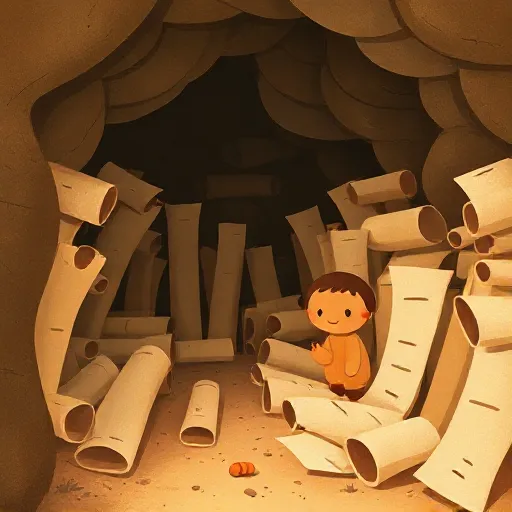

How Aristotle's Books Survived (And Why That's Weird)
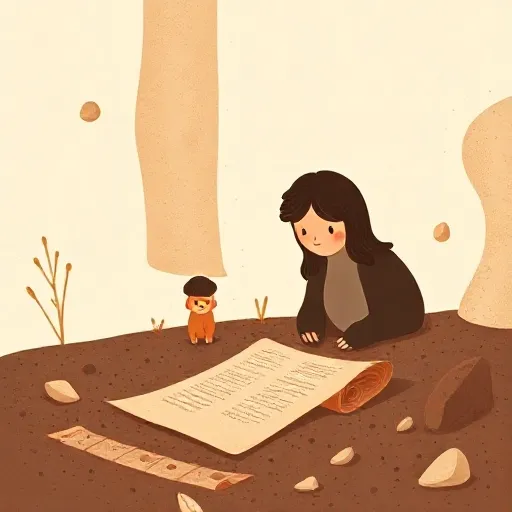
Imagine you write something brilliant. A poem, a story, an idea that changes how people think about the world. Now imagine that for almost two hundred years, almost nobody reads it. It gets stuffed into a hole in the ground somewhere in a small town. Worms eat parts of it. Moisture ruins pages. Some rich guy with questionable morals digs it up, tries to patch it together badly, and then it gets stolen by a Roman general who sacks Athens. Eventually, a scholar gets his hands on it and tries to make sense of the mess.
This is actually what happened to most of Aristotle’s books.
Aristotle died around 322 BCE. He was one of the most brilliant thinkers of the ancient world — he wrote about logic, physics, biology, ethics, politics, poetry, pretty much everything. But here’s the strange thing: for about 250 years after his death, almost nobody seems to have read his actual works. People talked about Aristotle, sure. But they didn’t seem to have his books. Then, suddenly, around the time of Julius Caesar, his writings re-emerged, were edited, and became the foundation for philosophy in Europe and the Islamic world for the next 1,500 years.
How did that happen? And how do we know what Aristotle actually wrote versus what got added, changed, or faked?
This is the puzzle at the heart of the story of Aristotle’s texts.
The Great Underground Library
The most famous story about what happened to Aristotle’s books comes from two ancient writers, Strabo and Plutarch. Here’s what they say happened:
After Aristotle died, his student Theophrastus inherited his library. Theophrastus was the new head of Aristotle’s school, the Lyceum in Athens. When Theophrastus died, he left the books to another student named Neleus. But Neleus didn’t stay in Athens. He took the books to his hometown, a small, unimportant place called Scepsis in what is now Turkey.
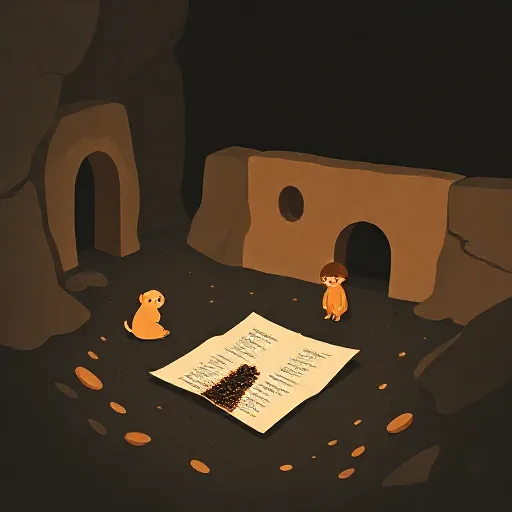
And there, the story goes, things went wrong. Neleus’s heirs weren’t interested in philosophy. Meanwhile, the nearby kingdom of Pergamon was building a huge library to rival the famous library in Alexandria, and they wanted every book they could get. So Neleus’s descendants, afraid their precious books might get stolen, hid them in an underground cellar or tunnel. There the books sat for decades, getting eaten by worms and damaged by dampness.
Eventually, around 84 BCE, a wealthy book collector named Apellicon of Teos bought the whole damaged collection. He was rich and enthusiastic but, according to Strabo, not very careful. He tried to fill in the missing bits himself, often getting it wrong.
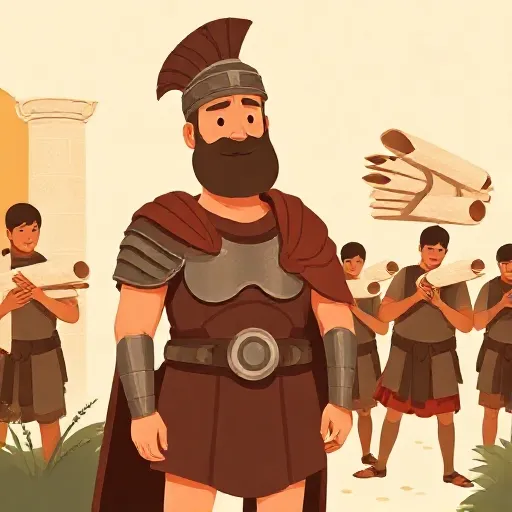
Then came the Roman general Sulla. In 86 BCE, he sacked Athens. Among the loot he carried back to Rome was Apellicon’s library. After Sulla died, a Greek scholar named Tyrannio got access to the books and started working on them. And then — finally — a scholar named Andronicus of Rhodes used copies of these rescued books to produce the first proper edition of Aristotle’s works, sometime between 75 BCE and 30 CE.
Andronicus is the only editor of Aristotle that ancient sources mention by name. He apparently organized the works by subject matter — putting logic together, physics together, ethics together — and created the basic arrangement that we still use today.
Wait, Is That Story True?
This is a great story. It’s dramatic, it has villains and heroes, and it explains why Aristotle’s works seemed to disappear for centuries. But historians have serious doubts about whether it’s entirely true.
Here’s the problem: was Aristotle’s work really lost? Or was the story exaggerated?
Consider this: within a generation of Aristotle’s death, his student Eudemus had made his own copies and taken them to the island of Rhodes. Other students had copies too. It’s hard to believe that only one copy of Aristotle’s works existed in the entire Greek world. The famous library at Alexandria, which was being built right around this time, probably had copies. In fact, another ancient writer named Athenaeus tells a completely different story — that the king of Egypt bought Aristotle’s books directly from Neleus for the Alexandria library. No underground hiding, no worms.
Also, if Aristotle’s works were truly lost and unknown for 250 years, how did people keep talking about his ideas? The philosophical schools that came after Aristotle — the Stoics, the Epicureans — clearly knew what Aristotle thought. They argued with his views. You can’t argue with a book you’ve never read.
What probably happened is more complicated. Aristotle’s works never completely disappeared. But they weren’t widely studied either. For most of the Hellenistic period (roughly 300–100 BCE), philosophers focused on other questions. The interest in Aristotle revived in the first century BCE, and Andronicus’s edition was part of that revival. But he wasn’t creating something from nothing. He was organizing, selecting, and arranging material that already existed.
Still, the legend of the lost-and-found library is powerful. It captures something real: we don’t know exactly how Aristotle’s texts survived, and the gaps in our knowledge are big enough to tell stories about.
The Messy Corpus
Here’s another puzzle. When you read Aristotle today, the works don’t always feel like finished books. Some parts are dense and technical, like lecture notes. Some parts seem to repeat themselves. Some parts contradict other parts. There are cross-references to works that don’t exist anymore, or maybe never existed at all.
The collection we have today — called the “Aristotelian corpus” — contains about 45 treatises. But we know from ancient lists that Aristotle wrote a lot more than that. He wrote dialogues (like Plato), which were polished and meant for a general audience. Those are all lost. He wrote collections of data — descriptions of animals, constitutions of different cities. Most of those are lost too. What we have are the “esoteric” works: the treatises he wrote for his students at the Lyceum, meant to be used in teaching, not published for the public.
These works were probably revised multiple times, both by Aristotle himself and by later students and editors. Think of it like a teacher’s lecture notes that get passed down, annotated, corrected, and added to over generations. Some sections might be notes Aristotle wrote in his thirties, mixed with revisions he made in his fifties, plus marginal comments added by a student who later taught the same material.
This explains some weird features of the corpus. For example, the Metaphysics — one of Aristotle’s most famous works — has two Book Ones. One is called Alpha (the first letter of the Greek alphabet) and the other is called “Little Alpha” (α). Both are introductions. Did Aristotle write two introductions at different times? Did an editor include both by mistake? Nobody knows for sure.
The Metaphysics also has what scholars call “doublets” — passages that appear twice, sometimes word for word. Book A chapter 9 is almost identical to parts of Books M and N. Either Aristotle reused his own material, or an editor copied it from one place to another.
Some books look like they were originally separate works that got stitched together. Book Delta of the Metaphysics is a dictionary of philosophical terms — it may have started as a separate reference work. Book Kappa is partly a summary of other books and partly material from the Physics. Scholars argue about whether Aristotle wrote it or whether it was a student’s summary that got included later.
The Categories Problem
Even the order of Aristotle’s works is controversial. The standard collection starts with the Categories, a short work about the different kinds of things that exist and how we talk about them. This is followed by On Interpretation (about statements and truth), then the two Analytics (about logic and proof), then the Topics (about argument strategies), and finally Sophistical Refutations (about logical fallacies). Together, these six works make up what’s called the Organon — Greek for “tool” or “instrument.”
But here’s the thing: Aristotle himself never called these works the Organon. He never grouped them together like this, and he didn’t think logic was a separate science. For him, logic was a tool you used in every science, not a science itself. The grouping happened later, probably by Andronicus or other editors.
And even within the Organon, there are problems. The Categories might not have been written as an introduction to logic at all. It deals with grammar, meaning, ontology (what exists), and psychology — a mix of topics that doesn’t fit neatly into a logic textbook. Aristotle’s ancient commentators already debated this. Andronicus thought the last six chapters of the Categories were added by someone else. He also thought On Interpretation was fake, based on a puzzling reference it makes to a work on the soul that doesn’t quite match up.
Other ancient editors disagreed. They kept both works in the collection. Andronicus’s views were mostly rejected.
The Ethics Puzzle
The ethical works are especially confusing. The modern corpus contains three ethical treatises: the Nicomachean Ethics, the Eudemian Ethics, and the Magna Moralia (“Great Ethics”). They cover similar topics in the same order — happiness, moral virtues, intellectual virtues, friendship — but with differences in detail.
Even stranger: the Nicomachean Ethics and the Eudemian Ethics share three books. Books V, VI, and VII of the Nicomachean Ethics are the same as Books IV, V, and VI of the Eudemian Ethics. These are called the “common books.” Modern editions sometimes include them in both works, but originally they could only have belonged to one. Which one? Scholars still argue.
The titles themselves are mysterious. “Nicomachean” could refer to Aristotle’s father (a famous doctor) or his son (who died young in battle). “Eudemian” refers to Aristotle’s student Eudemus. Did the son or the student write the books? Did editors dedicate them to these people? No one knows. Cicero, writing in the first century BCE, seems to think Nicomachus was the author. But later ancient writers were confused too.
Some scholars think the two Ethics are not really two separate works at all. Maybe they’re different versions of the same material, or different sets of lecture notes from Aristotle’s teaching. Maybe the “common books” are the original core, and the other books were added differently in different editions.
The Fakes
Not everything attributed to Aristotle is actually by him. The modern corpus includes about a dozen works that scholars agree are fake, or at least probably fake. Most were written within a few generations after Aristotle’s death, by members of his school or by people trying to pass off their work as his.
Some are obvious forgeries. The Rhetoric to Alexander starts with a fake letter from Aristotle to Alexander the Great, introducing a rhetorical handbook that was actually written by someone else. Others are harder to judge. The Problems — a huge collection of questions about natural phenomena — seems to contain material from Aristotle, Theophrastus, and later writers, all mixed together. The Mechanics raises questions about whether Aristotle would have used certain technical terms that appear in it.
Ancient scholars were aware that the corpus contained forgeries. The Neoplatonist commentator Ammonius gave three reasons for why this happened: kings paid huge sums for new texts for their libraries (which encouraged people to invent them); different works with similar titles got confused; and students sometimes published their own work under their teacher’s name to give it authority.
What We Actually Have
All of this might make you wonder: do we really have Aristotle’s authentic works? The answer is: mostly yes, but with caution. The core treatises — the Categories, Physics, Metaphysics, Nicomachean Ethics, Politics, Poetics, and others — are almost certainly genuine. The arguments, the style, the philosophical positions are consistently Aristotelian. The fakes are mostly on the margins.
But every text we have has been through centuries of copying, translating, editing, and commenting. Scribes made mistakes. Editors “corrected” things they found difficult. Commentators wrote notes in the margins that later copyers sometimes included in the main text. The earliest complete manuscripts we have of Aristotle date from the 9th and 10th centuries CE — about 1,300 years after Aristotle died. That’s a long game of telephone.
Still, ancient commentators like Alexander of Aphrodisias (around 200 CE) already had texts very similar to ours. And the medieval translations into Arabic and Latin, made from different manuscript traditions, generally confirm the same readings. The text is surprisingly stable, given everything it’s been through.
Why This Matters
The story of Aristotle’s texts matters because it shapes how we read him. When you notice that the Metaphysics has two introductions, you have to ask: what was Aristotle’s project? Was it a single unified work or a collection of separate investigations? When you see that the Ethics has three versions, you have to ask: which one represents his final view? When you find a confusing passage, you have to ask: did Aristotle write it this way, or did a scribe mess it up, or did an editor add something?
These aren’t just academic questions for specialists. They affect how we understand Aristotle’s ideas about the soul, about friendship, about what makes a good life, about how the universe works. And they remind us that philosophy doesn’t come to us pure and untouched. It comes through history, through accidents and decisions, through worms and generals and ambitious editors.
Appendices
Key Terms
| Term | What it means for this debate |
|---|---|
| Corpus | The whole collection of works attributed to a single author |
| Esoteric works | Writings meant for a small audience of students, not for public release |
| Authenticity | Whether a work was really written by the person it’s attributed to |
| Doublet | A passage that appears twice in the same work, possibly by accident |
| Cross-reference | When one text refers to another text, sometimes to a work that no longer exists |
| Common books | Books that appear in two different works (like the books shared by both Ethics) |
Key People
- Aristotle (384–322 BCE) – The philosopher whose works we’re trying to recover; founded his own school, the Lyceum, in Athens
- Andronicus of Rhodes (1st century BCE) – The only ancient editor of Aristotle we know by name; organized the works by subject and produced the edition that later scholars used
- Apellicon of Teos (died c. 84 BCE) – A wealthy book collector who bought the damaged collection from Scepsis and tried to repair it, probably badly
- Alexander of Aphrodisias (around 200 CE) – The greatest ancient commentator on Aristotle; his works are essential for understanding what Aristotle’s texts looked like in antiquity
Things to Think About
-
If you discovered that a famous author’s works had been lost for centuries, then found in a damaged state, and then edited by someone with their own ideas about how to organize them — how much would you trust that what you’re reading is what the author actually wrote?
-
The story about the underground library is dramatic and memorable. But historians think it’s probably exaggerated. Why do you think people keep telling it? What makes a good story more appealing than a complicated truth?
-
The Metaphysics has two Book Ones. If you were editing Aristotle today, would you include both, or pick one? What would you say to readers about why you made that choice?
-
Some works in the Aristotelian corpus are almost certainly fakes, but they’re still studied as part of the “Aristotelian tradition.” Should they be? Or should we separate them clearly? Where do you draw the line?
Where This Shows Up
- Every time you read a classic text – The same issues of transmission, editing, and authenticity apply to Plato, the Bible, Shakespeare, and almost any text from before the printing press
- When scholars argue about what an author “really meant” – These debates often depend on which version of the text they’re using, or which parts they think are authentic
- In modern editing – Editors of ancient texts still use many of the same techniques Andronicus used: comparing manuscripts, deciding which readings are correct, organizing material by subject
- In debates about intellectual property – The question of whether a student’s notes from a teacher’s lecture “belong” to the teacher or the student is not so different from what happened with Aristotle’s school materials