Can You Really Believe a Dog Is Not a Dog? Aristotle’s Weirdest Rule
A Dog That Is Not a Dog?

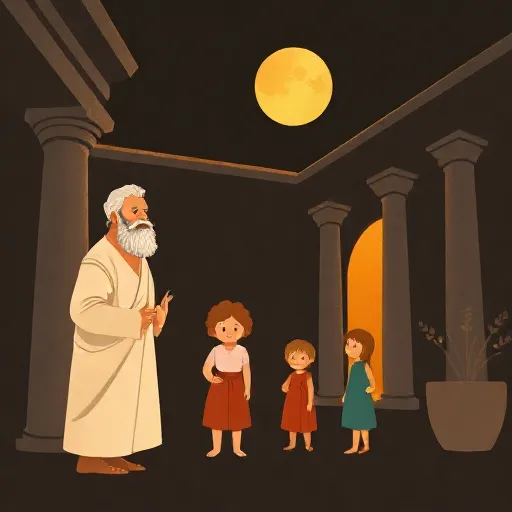
Imagine a sunny day in ancient Greece, around 340 BCE. A group of students sits in a circle, and one kid stands up, pointing at a scruffy dog. “That dog is a dog and also not a dog!” he declares. His friends giggle. But the grey-bearded teacher, Aristotle (384–322 BCE), does not laugh. He leans forward and asks, “What do you mean?”
This was no joke to Aristotle. He believed that the rule forbidding contradictions — the Principle of Non-Contradiction — is the bedrock of all thinking. In his view, it is simply impossible for the same thing to be both F and not‑F at the same time and in the same respect. If you try to break that rule, you do not just say something false; you stop making sense at all. Yet Aristotle knew that some people pretended to reject it, so he invented a clever trap. This article walks through that trap and why the rule still matters today.
Three Ways to Say “It’s Impossible”

Aristotle actually spotted three different ways the principle shows up.
The first is about things in the world — what he called the ontological version. It says: “It is impossible for the same thing to belong and not to belong at the same time to the same thing and in the same respect.” (The word “ontological” just means “having to do with what exists.”) A table can be actually red and potentially not red (you could paint it blue later). But it cannot be actually red and actually not-red right now. A person can be a “pitcher” in the baseball sense and not a “pitcher” in the jug‑that‑holds‑beer sense — but that is just one word with two meanings. The rule only applies when we talk about the same property in the same way.
The second version is about what we can believe — the doxastic version (from the Greek word doxa, meaning belief). Aristotle claims it is impossible to believe that the same thing both is and is not F. Critics push back: don’t people hold contradictory beliefs all the time? Aristotle’s reply is that you might say the words, but deep down you cannot really believe them. A modern twist says the doxastic version is not a description of messy human minds but a normative rule — you should not believe a contradiction if you want to be rational.
The third is about assertions — the semantic version: “Opposite assertions cannot be true at the same time.” If I say “That dog is brown” and you say “That dog is not brown,” both statements cannot be true — at least not in the same way about the same dog. Most scholars think this third formulation is really just a special case of the first, about things, put into words.
The Trap: “Just Say What You Mean”
If the principle is the firmest rule of all, you cannot prove it the way you prove that a triangle’s angles add up to 180°. Any proof would already have to assume it, so you would be begging the question. Aristotle instead used a special move called the elenchus — a kind of Socratic cross‑examination where the opponent refutes himself out of his own mouth.
He invites anyone who says they reject the Principle of Non-Contradiction to do one thing: signify some one thing — for example, “human being.” You must pick a word with a definite meaning. If “human being” means “two‑footed animal,” then it cannot at the same time be true that the very same thing is a human being (two‑footed animal) and is not a human being. If you refuse to give any fixed meaning, you are not saying anything at all.
This move ties the principle to what modern philosophers call Aristotelian essentialism. According to that view, things belong to natural kinds (like dog or human) and have essential natures. A person can dye her hair and remain human, but she cannot stop being human without ceasing to exist. Accidental properties like “pale” or “musical” need a subject — a substance with an essence — to belong to. If everything were just a loose bundle of accidents with no solid core, contradictions would run wild, because nothing would definitely be anything.
Aristotle’s opponent might try to wriggle away by saying “I’m not talking about substances, just appearances.” But even then, the moment his words mean something definite — the moment he commits to saying “this is pale” — he has surrendered. The trap snaps shut.
Even If You Stay Silent, Your Actions Shout
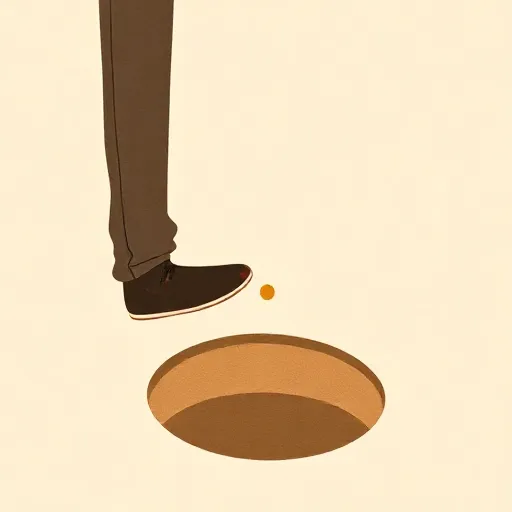
What if the opponent refuses even to speak? Aristotle has a second move. You must still act, and the way you act betrays what you really think. Nobody strolls into a well or over a cliff “just because.” You avoid the well because you believe it is not a safe path — and you cannot simultaneously believe it is safe and not safe and still act as if it matters.
An objector might say that you can act as if you hold consistent beliefs without actually holding them. This idea appears later in skeptical philosophy: maybe we just follow how things appear to us, without committing to any firm truth. But Aristotle would ask whether even appearances can seem both F and not‑F to the same person at the same time. If you jump back from a snake, even a “fake” snake, your startle shows that your body has already decided the snake is one thing and not its opposite.
When Your Senses Play Tricks on You
Aristotle knew that many earlier thinkers were puzzled by change and conflicting appearances. A wind feels cold to you but warm to me. A distant tower looks round but turns out to be square up close. Some philosophers concluded that nothing is definitely true, or that everything is equally true. One famous figure, Protagoras (5th century BCE), taught that “each individual human being is the measure of all things” — what appears true to you is true for you, and what appears true to me is true for me. Protagoras’s view, Plato and Aristotle argued, eventually forces you to reject the Principle of Non-Contradiction entirely.
Aristotle responds not by picking a majority vote, but by pointing out that we already know which perceptions to trust. When you are awake, you do not seriously believe your dream of Athens while you are standing in Libya. You trust your close‑up vision over your blurry distance vision when you want to know a color. Each sense is an authority on its own special object: sight tells you about color, taste about flavor. So his opponents, through their own daily habits, show which appearances they really take as reliable.
He also draws a sharp line between potential and actual. A lump of clay can be potentially a cup and potentially not‑a‑cup, but it cannot be actually a cup and actually not‑a‑cup right now. Many apparent contradictions stem from confusing what something could be with what it is.
Why It Still Matters: The Fight Over Contradiction

The debate did not end with Aristotle. Today, a group of philosophers called dialetheists argue that some contradictions really are true — for instance, the sentence “I am lying.” If the sentence is true, then I am lying, so it is false; if it is false, then I am not lying, so it is true. Dialetheists think this is a genuine case of something being both true and false. They claim Aristotle’s arguments simply assume the very rule he is trying to defend.
Aristotle would likely answer that without the Principle of Non-Contradiction, you cannot have a rational argument at all. Every counterclaim you make already depends on the idea that your statement is not also false in the same way at the same time.
That might seem like a dusty old quarrel, but it touches your life every day. If contradictions were allowed to run free, you could never settle a disagreement. You could never trust a sign or a promise. You could not even plan what to eat for lunch, because “I want a sandwich” and “I do not want a sandwich” would both be fine. The rule is less a dry piece of logic and more an invisible guardrail that keeps thought and conversation on the road.
So next time someone tries to convince you that “yes means no and no means yes,” you could try Aristotle’s old trick. Just ask them, politely: “What exactly do you mean?”
Think about it
- If a friend tells you, “I am lying right now,” would you say the sentence is true, false, or something else? Why is that puzzle so tricky?
- Can you think of a time when it seemed like something was both true and false at once, but you later realized the same word was being used in two different ways?
- Suppose someone argues, “Your opinion is true for you, and mine is true for me.” Can you still have a real argument with that person? What would you lose if you always agreed to that rule?