What If Everything Had a Purpose — Even Rocks?
What Would Aristotle Ask About Your Lunch?

He stood ankle-deep in the Aegean Sea, turning a spiny sea urchin over in his palm. It was around 344 B.C.E., and the man was Aristotle (384–322 B.C.E.). He had left Athens and was living on the island of Lesbos, spending his days not just doing philosophy but poking around tidal pools, cutting open fish, and asking a question most people never think to ask: What is this for?
That question — “What is it for?” — became the engine of Aristotle’s entire philosophy. He asked it about sea urchins and stars, about friendship and courage, about governments and poems. And he asked it about you.
To understand why Aristotle still matters, you have to understand how he worked. He did not sit in a dark room and try to think up the truth from scratch. He believed our senses and our minds are basically trustworthy. When something puzzled him, he started by looking at how the world actually appears — what he called the phainomena (the Greek word for “appearances”). Then he collected what smart people before him had said about the puzzle — the endoxa, or “credible opinions.” Only after gathering both did he start sorting through them, keeping what held up and tossing what didn’t.
Imagine you are trying to figure out why your friend is angry. Aristotle’s method says: first, notice what actually happened — the phainomena. Your friend stopped talking to you after lunch. Then, collect the endoxa: your other friends think you said something rude. Your own memory says you made a joke. Now you sort through it. Maybe the joke landed badly. Maybe something else is going on. You don’t just guess. You work from evidence toward an answer.
Aristotle did this with everything. When he wanted to understand time, he started with how time appears to us — it passes, it goes one way, you can’t get it back — and then worked through every puzzle those appearances created. For him, philosophy always began in the middle of real life, with real confusion.
The Four “Whys” Behind Everything

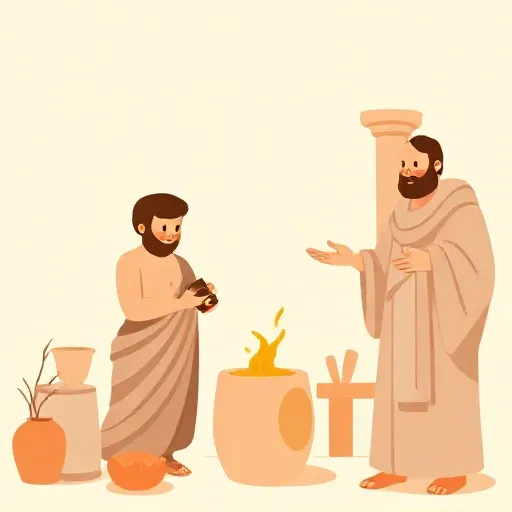
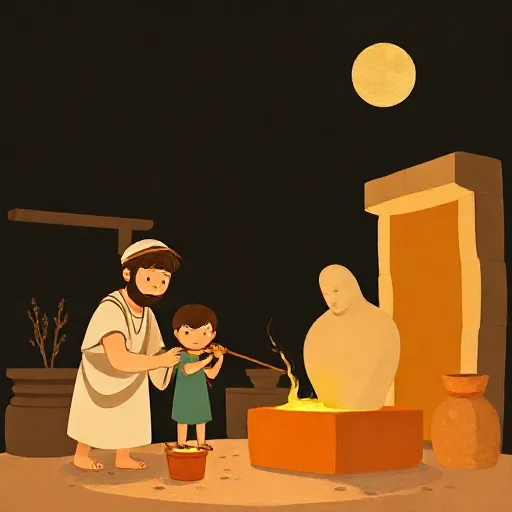
Imagine you walk into a room and see a bronze statue of a woman you don’t recognize. You have questions. What is it? What is it made of? Who made it? What is it for?
Aristotle noticed that when we try to understand anything, we spontaneously ask exactly these four questions. He turned that observation into one of the most influential ideas in the history of thought: the four causes. But by “cause” (in Greek, aitia), he meant something broader than we usually do. He meant anything that helps explain why a thing is the way it is.
The four are these. First, the material cause: what something is made of. For the statue, that’s bronze. Second, the formal cause: the shape or pattern that makes it what it is. The bronze didn’t become a statue until it took on a particular form — the shape of that woman. Third, the efficient cause: what brought it into being. That’s the sculptor who shaped the metal. Fourth, the final cause: the purpose or goal. The statue was made to honor someone.
Aristotle believed that giving all four of these explanations was necessary for truly understanding something. Leave one out, and your explanation is incomplete. And he went further: he thought these four causes are real features of the world, not just convenient ways of talking. The bronze really is there. The form really is there. The sculptor really did the work. And the purpose — that’s real too.
Now, you might think the first three causes are obvious. But the fourth one — final causes, or purposes — is where things get interesting, and controversial.
Can a Rock Have a Purpose?

If you find a pocketknife on a hiking trail, you know immediately that it has a purpose. Someone designed it to cut, to open cans, to screw things in. Its purpose comes from a designer. But Aristotle took a more radical step. He believed that nature itself is full of purposes — and that no designer is required.
This is called teleology, from the Greek word telos, meaning “end” or “goal.” Aristotle thought you could see teleology everywhere in the living world. Teeth don’t just happen to be arranged with incisors in front and molars in back — they are arranged that way for tearing and grinding food. Leaves grow for shading fruit. Kidneys exist for filtering blood. None of this, he insisted, requires a divine designer. The purposes are built into nature itself.
His main argument went like this: things in nature happen either always (or almost always) in regular, predictable patterns, or they happen by chance. But the regular patterns — teeth always growing in a certain arrangement, acorns always growing into oaks — can’t plausibly be chalked up to chance. So they must happen for a reason. They must have a final cause.
This argument has problems, and Aristotle partly knew it. He admitted that some regular features of living things — like the yellowness of bile — seem to have no purpose. They’re just side effects. But he still maintained that the natural world is shot through with genuine purposes, not just in whole organisms but in their parts.
For Aristotle, this meant that to explain why a thing is the way it is, you often have to say what it is for. And that idea reaches all the way into his thinking about the most important question of all: what is a human life for?
What Is Your Job as a Human?

Aristotle noticed that we have no trouble saying what makes a good knife (it cuts well) or a good eye (it sees clearly). A thing is good when it performs its function — its ergon, its characteristic work — with excellence. So he asked: does a human being have a function? And if so, what is it?
His answer was that humans do have a function, and it is this: to live a life guided by reason. Plants live too, but they only grow and take in nutrients. Animals live and perceive the world. But humans, uniquely, can reason. So the function of a human being is “activity of the soul in accordance with reason” — and doing that well is what Aristotle called eudaimonia.
Translators argue about how to render eudaimonia. “Happiness” is the common choice, but it’s misleading if you think happiness is just a feeling. “Flourishing” or “living well” come closer. Aristotle meant something objective: you flourish when you fully realize what you are, when you use your human capacities excellently.
This is not a matter of opinion, he thought. Just as you can be wrong about whether a knife is sharp, you can be wrong about whether a life is going well. Someone might think they’re happy spending all day scrolling on their phone — but if they’re not using their capacity for reason, for friendship, for courage, for understanding, then by Aristotle’s lights, they’re missing the mark. They’re not flourishing.
He then spent a great deal of his Nicomachean Ethics investigating the particular virtues or excellences (aretai) that make up a flourishing life: courage, temperance, justice, practical wisdom, and more. A virtue, for Aristotle, is not just a nice trait. It’s a skill at living — a stable disposition to act, think, and feel in the right way, at the right time, toward the right people, for the right reasons. You develop virtues the way you develop any skill: by practicing. You become brave by doing brave things. You become just by acting justly.
And crucially, Aristotle thought you can’t flourish alone. Human beings are political animals — we need a polis, a political community, to live well. That’s why his ethical theory leads directly into his political theory: the point of a good government is to create conditions where citizens can flourish.
Why Aristotle Still Walks With Us

After Aristotle died in 322 B.C.E., his works disappeared from circulation for roughly two centuries. When they resurfaced, they didn’t just get read — they became the backbone of philosophy for the next seven hundred years. In the Islamic world, he was known simply as “The First Teacher.” Thinkers like Avicenna (980–1037) and Averroes (1126–1198) wrote brilliant commentaries on his work. In the Latin West, Thomas Aquinas (1225–1274) wove Aristotle’s ideas into Christian thought so thoroughly that for centuries, “The Philosopher” — with a capital P — meant Aristotle and nobody else.
His influence has never really stopped. When philosophers today argue about virtue ethics — the idea that living well is about developing good character rather than just following rules or calculating consequences — they are picking up a conversation Aristotle started. When biologists ask whether teleological language (“the heart is for pumping blood”) is just a metaphor or something more, they’re wrestling with his legacy.
But you don’t need to be a professor to feel Aristotle’s pull. Every time you wonder what you should do with your life — what kind of person you want to become, what it would mean to really flourish — you’re asking his questions. His answer is that those questions have real answers, not just whatever you happen to prefer. And that’s both a challenge and a promise: the challenge is to figure out what those answers are. The promise is that it’s possible to do so.
Think about it
- If Aristotle is right that everything has a purpose, what would the purpose of something like boredom or sadness be? Can a painful emotion be for something?
- Aristotle thought you could be genuinely wrong about whether your own life is going well. Do you agree? Can you think of a case where someone thinks they’re happy but isn’t?
- If you had to name one activity that lets you use your human capacities most fully — the thing that makes you flourish — what would it be? How do you know?