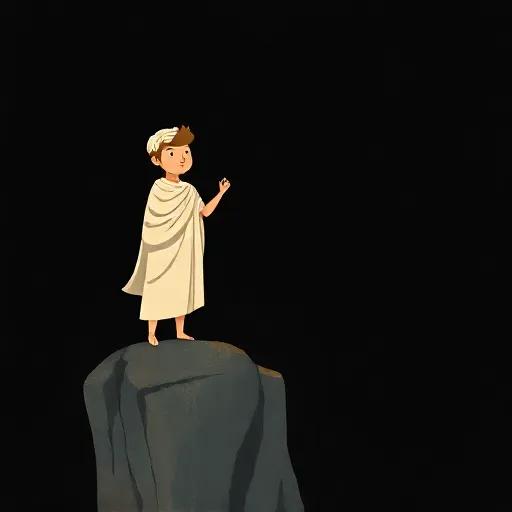
What Happens If You Stick Your Hand Beyond the Edge of the Universe?
A Ship to Save a Philosopher
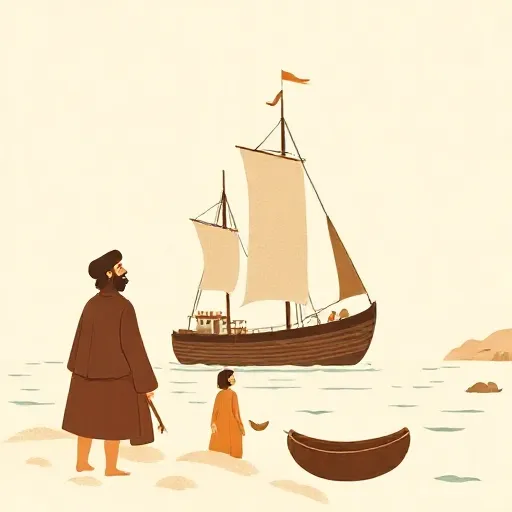
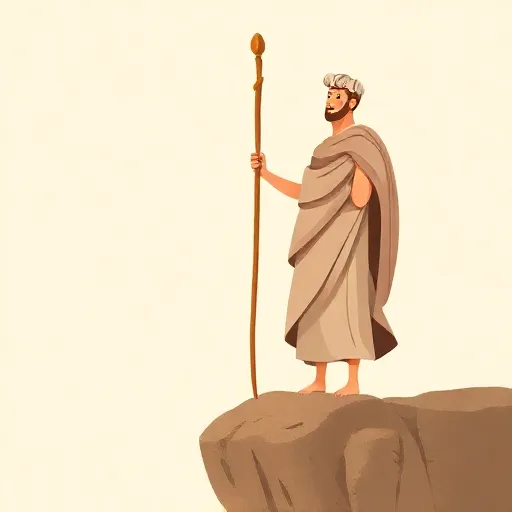
In 361 BCE, Plato was in trouble. The famous philosopher was trapped in Syracuse, on the island of Sicily, by Dionysius II, a tyrant he had tried to teach. Plato desperately needed to escape. Help came from across the sea, from the Greek city of Tarentum in southern Italy. A powerful statesman and general named Archytas (c. 435–350 BC) sent a ship to rescue him. This dramatic rescue made Archytas famous, but it is only one chapter in the story of a thinker who was a mathematician, a music theorist, a politician, and one of the most inventive minds of the ancient world.
Archytas grew up in Tarentum, a democratic city-state with a busy harbor and a strong army. He was a Pythagorean — a follower of the ideas of Pythagoras, who believed that numbers were the key to understanding everything. Archytas learned from the Pythagorean Philolaus (c. 470–390 BC) and became a brilliant mathematician in his own right. He was so trusted by his fellow citizens that they elected him general seven years in a row, even though the law usually forbade consecutive terms. He was never defeated in battle. Yet his greatest battles were fought with ideas, not swords.
The Puzzle of the Double Cube

One of the most famous puzzles in ancient geometry was the duplication of the cube. According to legend, the people of Delos were struck by a plague and an oracle told them that if they doubled the size of a cube-shaped altar, the plague would stop. At first they simply built a second identical altar on top of the first. That gave them double the volume, but the result was a rectangular block, not a cube. So they tried doubling the length of each side. That produced a cube eight times the volume — far too big. The real problem was: what side length gives exactly double the volume while keeping the shape a perfect cube? The Greeks realized they needed to find two mean proportionals between the original side and a line twice its length. This turned out to be incredibly difficult.
Archytas was the first person to solve it, and his solution is breathtaking. Unlike earlier attempts that used simple flat diagrams, Archytas built his reasoning in three dimensions. He imagined a rotating semicircle and a rotating triangle, each sweeping across the surface of a half-cylinder. Their intersection created a point that allowed him to construct four similar triangles, and from those triangles he could identify the required length. No physical machines were involved — it was a pure geometrical demonstration. Later writers sometimes claimed Plato scolded Archytas for using mechanics, but that story is probably a later invention. What is certain is that Archytas advanced solid geometry further than anyone had before, and his solution was admired for centuries.
Music Made of Numbers
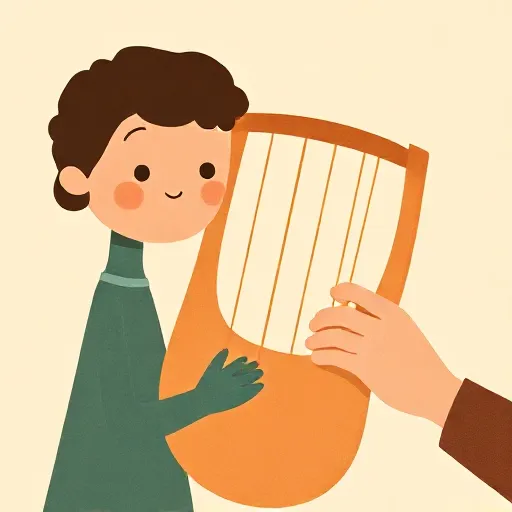
Archytas didn’t only think about shapes; he thought about sounds. The Pythagoreans had discovered that the most pleasing musical intervals — the octave, the fifth, and the fourth — correspond to simple whole-number ratios of string length. A string half as long as another sounds an octave higher (ratio 2:1). The fifth is 3:2, the fourth is 4:3. Archytas pushed this insight much further. He wrote a book called Harmonics in which he proposed a scientific theory of pitch: sound travels through the air, and a quicker-moving sound produces a higher pitch. (He was right that speed matters, though today we know it is frequency, not travel speed, that determines pitch.)
Archytas then turned to the structure of musical scales. He provided a rigorous mathematical proof that a superparticular ratio — a ratio of the form (n+1):n, like the ones in music — can never be divided into equal halves. No mean proportional exists between such numbers. Because of this, you can’t split a whole tone (9:8) into two identical half-tones; the math simply forbids it. This proof became a cornerstone of ancient music theory and was later included in a textbook attributed to Euclid.
But Archytas went even further. He described three different types of tetrachord (the basic pattern of four notes spanning a fourth) used by real musicians of his time: the diatonic, the chromatic, and the enharmonic. For each he gave exact ratios that matched the tuning a listener would actually hear. This brought him into conflict with Plato. Plato complained that Pythagoreans like Archytas were too busy measuring “heard harmonies” instead of asking deeper questions about why certain numbers are harmonious in the first place. Plato wanted mathematicians to leave the physical world behind; Archytas wanted to find the numbers inside the world we hear every day.
Sticking Your Hand Beyond the Stars
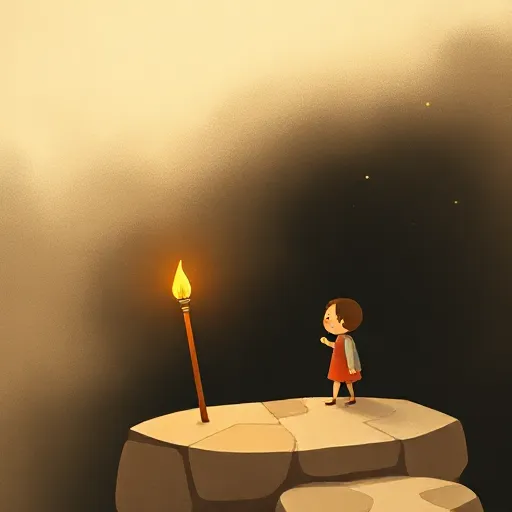
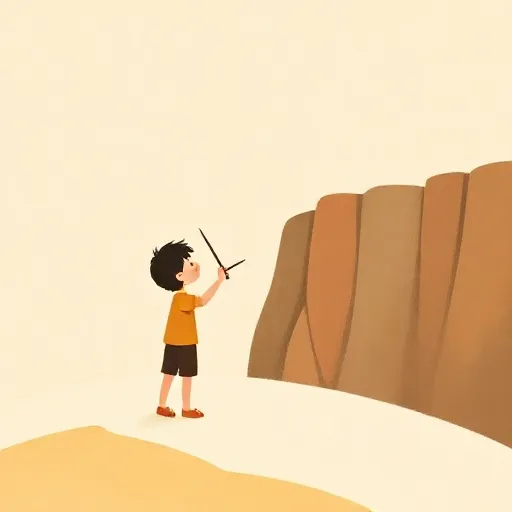
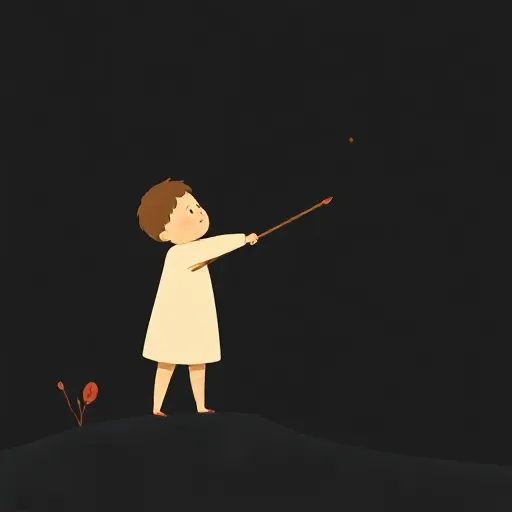
What is at the very edge of everything? Ancient philosophers often imagined the universe as a finite sphere with a boundary. Archytas challenged this with one of the earliest recorded thought experiments. He said: suppose you travel to the outermost edge of the universe. You carry a stick in your hand. When you reach the boundary, can you extend the stick beyond it, or not? It would be absurd to say you cannot — there is nothing solid blocking your arm. So you push the stick outward. Now the tip of the stick is at a new position, beyond what you thought was the limit. You can walk to that new spot and repeat the question. Every time you extend the stick, you find more space. The only conclusion is that space is unlimited.
Neither Plato nor Aristotle accepted this argument; they both held that the cosmos is limited. But the argument haunted later thinkers. Epicureans and Stoics adopted versions of it to support an infinite universe. Centuries later, John Locke and Isaac Newton returned to Archytas’s reasoning when they thought about absolute space. Even though modern physics entertains the possibility of a finite but unbounded space (like the surface of a sphere, which has no edge), Archytas’s demand — to show him the edge and step beyond it — still forces us to think carefully about what a boundary could possibly mean.
Calculation for a Just City
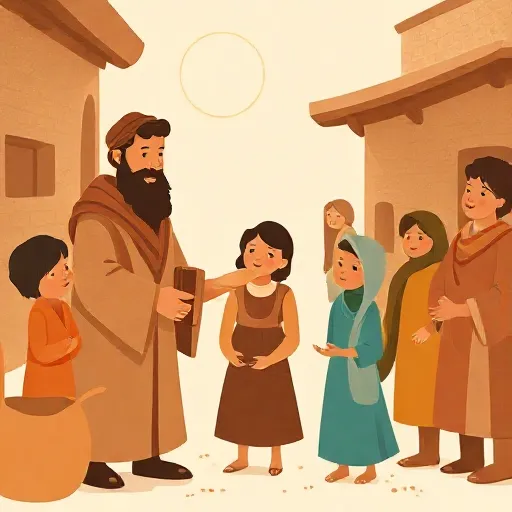
Archytas didn’t keep numbers locked inside music and geometry. He thought they could repair a whole city. In a short fragment from his work On Sciences, he says that once logismos (rational calculation) was discovered, discord stopped and harmony grew. When people can compute what a fair share looks like, they no longer grab for more than they deserve. The rich give to the poor in confidence that they will receive what is fair. Equality exists because of calculation.
Notice that Archytas didn’t aim for a kingdom ruled by philosopher-kings with secret knowledge. He relied on a basic human ability to reckon and to understand simple proportions — something everyone, rich and poor, can share. This idea fits with his own democratic city, where he was elected by the people. For Plato, true justice required a tiny elite with years of mathematical training. For Archytas, calculation was already a public tool for resolving conflict.
The ethical stories told about Archytas reinforce the same picture. When he became furious with a slave who had blundered badly, he refused to punish him in the heat of anger. Instead he walked away and said that it was a good thing he was angry, or the slave would not have gotten off so easily. He recognized that reason should rule, not emotion. In another confrontation, a defender of constant pleasure-seeking argued that the best life is one of pursuing bodily enjoyment. Archytas replied with a second thought experiment: imagine someone experiencing the most intense bodily pleasure possible. In that moment, would that person be able to think clearly or make rational calculations? Probably not. Bodily pleasure, in its extreme, seems to silence reason itself. For Archytas, the good life could not be built on something that blocks the very faculty — rational calculation — that makes us human.
Why Archytas Still Matters
Archytas never separated numbers from the real world. He found them in the vibrating strings of a lyre, in the three-dimensional curves that double a cube, and in the gesture of a hand reaching past the last star. He used them to argue that political life should be governed by fairness anyone can calculate. In every direction he pushed the same conviction: if you look closely at anything — a sound, a shape, a society — you will find proportions.
Today, when you tune a guitar, you are relying on the same ratios Archytas analyzed. When you picture an infinite universe stretching beyond your imagination, you are dancing with his thought experiment. And when you and your friends try to divide something fairly — whether a cake or a set of chores — you are using a quiet, everyday form of logismos. Archytas believed that kind of thinking could make the world more just. Maybe he was right.
Think about it
- If you could travel to the edge of the universe, what would you expect to find? Why does it seem impossible for the universe to just stop?
- Archytas thought calculation could help rich and poor live together fairly. Can you think of a situation today where math might solve a conflict over resources?
- Musical intervals can be described by simple ratios, like 2:1 for an octave. Why do you think our brains find those combinations pleasant? Is there something mathematical about beauty?