
Is That Building Art? The Fight Over What Counts as Architecture
Is a Bus Shelter Architecture?

You walk down your street. You pass a bus shelter, a glass-and-steel office tower, and a sagging shed your neighbor built for a lawnmower. Are all three “architecture”? The question looks simple, but philosophers have argued about it for centuries. The ancient Roman architect Vitruvius (1st century BCE) thought a building had to satisfy three things at once: firmitas (it stands up), utilitas (it does something useful), and venustas (it is beautiful). That three‑legged stool is the Vitruvian triad, and it still shapes the debate. Yet the triad does not settle the bus shelter question. A shelter is useful, it stands, and it might even look sleek—but many people would hesitate to put it in the same category as a cathedral or a museum. Why? Because we sense that architecture should have a special weight, an intention to delight or to mean something. So the puzzle is: does architecture include every designed built thing, or only the ones that aim to be art?
Are Buildings Art?

To answer that, philosophers split into two rough camps. Exclusivists say architecture is a narrow club. The philosopher Roger Scruton (1944–2020) insisted that architecture should “exalt” us—lift our spirits, not just keep out rain. On his view, a humble shed or a cookie‑cutter apartment block simply does not belong because it has no higher purpose. Inclusivists, by contrast, throw the doors wide. Allen Carlson (b. 1943) argues that the built environment is one continuous field: a garage door, a drainage ditch, a glass skyscraper—all of it is architecture, because we can and do appreciate it aesthetically. Robert Stecker (late 20th–early 21st century) lands in the middle. He suggests that, as a creative medium, every built thing is architecture; but as an artform, only the ones made with clear artistic intent deserve the label.
This spills into a related fight: is architecture an artform at all? The philosopher Stephen Davies (late 20th–early 21st century) claims architecture is more like a craft, because its main job is to produce useful objects, not artworks. A fork or a chair can be beautiful, but that does not make cutlery an artform. Stecker pushes back, pointing out that architecture was included on early lists of the fine arts, and that some buildings—the Sydney Opera House, for example—are clearly intended as art, even if not all buildings are. Exclusivists often draw the line between a striking work by a named architect and the humdrum design of a draftsman. Inclusivists counter that even the humdrum has a creator we call an architect, and that labeling the shed “architecture” simply acknowledges the training and ethos behind it.
Beautiful Because It Works

So what makes an architectural object beautiful? One powerful idea is functional beauty. Immanuel Kant (1724–1804) argued that architecture exhibits dependent beauty: its beauty depends on what it is for. A beautiful chair must also be comfortable; a beautiful library must invite reading. Much later, Glenn Parsons and Allen Carlson developed a full theory: an object possesses functional beauty when it looks as if it was made perfectly for its function. A well‑designed bus shelter that elegantly sheds rain and frames a clear view of the street can be beautiful because it works.
Formalists think this gives too much power to function. They claim that what matters are the shapes, colors, and rhythms of a building itself—its formal properties. Anti‑formalists reply that you cannot understand a building’s beauty without knowing its story. Take I. M. Pei’s glass pyramids at the Louvre. Their pure geometry is striking, but their beauty also comes from the contrast with the ornate neo‑Baroque palace that surrounds them, and from a whisper of the ancient Egyptian pyramids. Cut that history away and you lose part of what makes them work.
Then there are ruins. A broken Roman arch has no function left, yet people find ruins breathtaking. That is a challenge for functional beauty theory, because the ruin is beautiful in a way that has nothing to do with a job being done. So perhaps architecture’s beauty comes from a mix of pure form, context, fitness for purpose, and even the passage of time. No single recipe covers every case.
Do Buildings Speak?
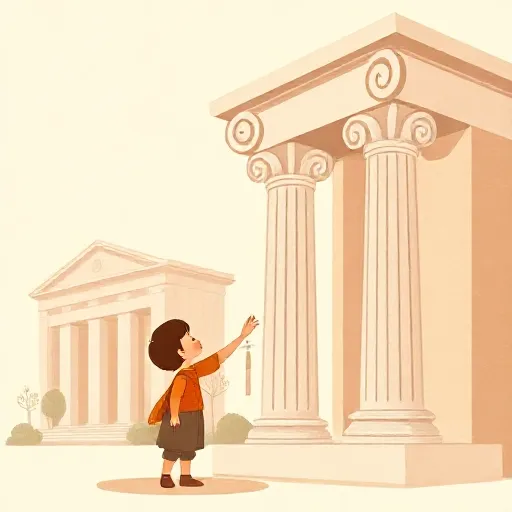
For centuries, thinkers believed architecture worked like a language. The idea is the architecture‑as‑language thesis. Vitruvius treated the classical orders—Doric, Ionic, Corinthian—as a kind of grammar: columns were assembled according to rules, and each order carried a meaning. For Renaissance architects, the Ionic order with its curled volutes signaled scholarly wisdom; to a later French architect it meant “gravitas”; to the designers of New York’s City Hall it suggested good government. On this view, you could “read” a building the way you read a sentence.
Most philosophers today reject the thesis as literal truth. Grammars have strict rules, and missing a word changes what you say, but architecture does not work that way—there are no architectural truths or falsehoods. Still, even critics admit that the metaphor is useful. Buildings can express feelings or ideas. A courthouse with a stern row of columns can make you think of justice and stability; a chaotic, jagged cluster of roofs might express anxiety or rebellion. The American philosopher Nelson Goodman (1906–1998) argued that buildings mean things by symbolizing properties—they exemplify shapes, materials, or rhythms that we associate with ideas. Communications no, a kind of suggestion yes.
How Buildings Shape Your Life

Architecture does not just sit there. It nudges your body, your mood, and even your sense of power. The philosopher Francis Sparshott (1926–2015) once called architecture “…above all the coercive organization of social space”. That sounds dramatic, but think about a prison. The English thinker Jeremy Bentham (1748–1832) sketched the Panopticon, a circular jail where a single guard in a central tower could see into every cell at once. The design was meant to make prisoners feel they were always being watched, so they would discipline themselves. Even in ordinary life, buildings steer you: a low ceiling can make you huddle, a broad plaza can make you feel small or important, an open staircase can invite you to climb.
Because architecture can shape behavior and well‑being, it raises ethical questions. Architects design spaces for people, and that means they have responsibilities—to make places safe, accessible, and decent. Should a building give you privacy or expose you? Should a hospital calm you or just be hygienic? And who gets to decide? Those questions are political as well as moral. When planners choose a fortress‑like design for a police station instead of a welcoming community center, they are choosing values. The French historian Michel Foucault (1926–1984) argued that architecture has often been used to maintain power and organize people without them noticing. So the next bus shelter you see is not just a roof; it is a small decision about how strangers share a sidewalk.
Why You Should Care About Every Brick

You live inside architecture the way a fish lives inside water. The argument between inclusivists and exclusivists is not just a squabble among professors. It determines which buildings get preserved as landmarks, which neighborhoods are allowed to develop, and what kind of spaces get built in the first place. If you think only beautiful, high‑art buildings really count as architecture, you might accept ugly but useful buildings as unavoidable. If you think everything built is architecture, then every garage and drainage ditch is open to the same critical questions: does it work? Does it lift people up or wear them down? Could it be better?
The Vitruvian triad—strength, usefulness, beauty—still offers a simple way to start. Next time you walk down your street, pick any structure and run it through the three questions. Does it stand? What is it for? Does it please the eye, or does it make you feel uneasy? The ancient debate lives in that glance. And the answer to “What makes good architecture?” is, in part, yours to argue about.
Think about it
- If a building is ugly but keeps people perfectly dry and safe, is it a success—or is something missing that only beauty can provide?
- Should we preserve a beautiful old ruin that has no function, or tear it down to build something that people actually need today?
- If a building makes you feel watched and controlled, like a panopticon, can it still be a good building for someone else—and who gets to decide?