
Do Numbers Exist Outside Your Mind? A Medieval Muslim Debate
A Question Over Dates: Where Does the Three Go?

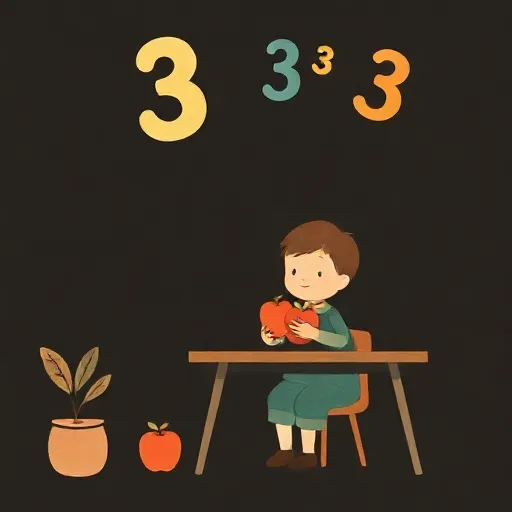
Imagine you live in Baghdad, around the year 1000. You are studying with a famous teacher. You hold out three juicy dates to him. He takes one and asks, “If I eat all three, where does the three go? Does it still exist somewhere?” At first, the question seems silly: three is just a word we use. But philosophers have taken it seriously for centuries. They argue about whether numbers, shapes, and other mathematical things are real outside our minds or only inside them. Medieval Muslim scholars fought a long, lively battle over this. Their ideas still echo today.
Plato’s Followers: Numbers in a Perfect World

About a thousand years before our Baghdad scene, the Greek philosopher Plato had claimed that mathematical objects—like the perfect circle or the number two—exist in a separate, immaterial realm. They are separate from physical things. Plato and later Pythagoreans also held a second idea: that these mathematical objects are the principles or causes of natural things. In other words, a triangle’s perfect form makes all wooden triangles possible. Many early Muslim thinkers, such as the Brethren of Purity and some early Mutazilites, found these ideas attractive. They called numbers separate substances (SM for short) and said they have principalness (PM), meaning they are the deeper causes of the physical world.
But before long, a brilliant philosopher named Avicenna (also known as Ibn Sina, c. 980–1037) would tear these ideas apart.
Avicenna’s Attack: Separateness and Principles Fall

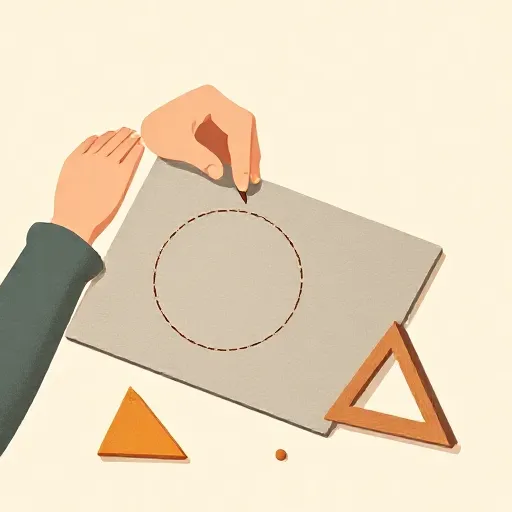
Avicenna offered two crushing arguments against the Platonist picture. First, he challenged the claim that mathematical objects are separate in existence because we can define them without mentioning matter. He said: there is a difference between defining something without the condition of matter and defining it with the condition of being immaterial. You can think about a triangle without bringing up wood or stone, but that doesn’t mean the triangle exists as a ghostly, completely immaterial thing. A triangle can be defined without matter, but not with the condition that it must lack matter. So the argument for separateness fails.
Against the principalness thesis, Avicenna pointed out a logical slide. Even if mathematical objects were separate, that wouldn’t automatically make them the principles of natural things. Maybe some other immaterial things—like angels or divine intellects—are the real principles. The Platonist argument only works if you already assume that mathematical objects are the only separate existents, which nobody had proved.
He also attacked the whole idea that separate mathematical forms cause things in the physical world. Suppose a separate “perfect triangle” is the cause of a wooden triangle. What makes the wooden triangle need it? If it’s because of their shared essence (what makes both a triangle), then the perfect triangle would also need a cause, leading to an infinite chain of triangles causing triangles—absurd. If it’s because of accidents (like color or size), those accidents exist only after the wooden triangle exists, so you can’t use them to explain why the wooden triangle needs the separate one without going in a circle. Avicenna thought this showed that separateness and principalness were both dead ends.
Avicenna’s Own Answer: Numbers are Properties, Not Ghosts
So if mathematical objects aren’t separate spirits, what are they? Avicenna, following the earlier philosopher al-Fārābī (c. 872–950), said that numbers and magnitudes are accidents—properties—of physical objects. When you see three apples, the three-ness is a real feature of that group of apples, just like their redness or roundness. You don’t see “three” with your eyes, but a special inner faculty called estimation (wahm) grasps it. Estimation allows you to “abstract” the number from this particular apple or that lump of gold, but you still think of it as something attached to matter. A number in mathematics is not fully immaterial—it remains connected to material things, at least in your mind.
Avicenna’s view made mathematical objects part of the physical world, not a separate realm. Yet he also held that mathematics deals with perfect, idealized versions of these properties, which exist exactly only in the mind through the work of estimation and imagination. This led to a big debate among later scholars: are mathematical objects real in the physical world, or are they only mental constructs?
Later Thinkers: Maybe Math is Just in Our Heads

After Avicenna, many philosophers grew suspicious of the idea that numbers and shapes literally exist in the physical world. Suhrawardī (d. 1191) gave a famous argument against four-ness being a real accident of four people. If you have four individuals, where is the four-ness? It isn’t complete in any one person, and it can’t be spread out in bits. He concluded that numbers are only mind-dependent—they exist solely in our intellect. Later, Mullā Ṣadrā (d. 1640) made a similar point: the mind imposes a unity on separate things; the unity doesn’t exist out there.
This shift raised a huge worry: if mathematical objects are purely mental, how can math give us reliable knowledge of the real world? To solve this, some thinkers appealed to the concept of nafs al-amr (roughly “the thing itself”), a mysterious realm where mathematical truths are grounded even if mathematical objects aren’t physically real. The idea was that a judgment like “2 + 2 = 4” is true in nafs al-amr, not because numbers float around, but because reality itself has a mathematical structure that our minds correctly grasp. This allowed them to be realists about mathematical truth while being anti-realists about mathematical objects.
The Infinity Puzzle: How This Debate Touches Big and Small

The question of what mathematical objects are became especially sharp when philosophers thought about infinity. Avicenna and others used the Mapping Argument to show that no actually infinite magnitude can exist in the physical world. Imagine an infinitely long line. Remove a finite piece from the start. The remaining line can be placed next to the original and matched point-for-point—a one-to-one correspondence. By Euclidean common notions, the original and the shortened line would be equal, even though one is a proper part of the other. That’s absurd. So infinite lines can’t exist in reality.
For those who believed mathematical objects are physical properties (like Avicenna), this meant that infinite numbers and infinite sets can’t exist either. But some later thinkers, like Fakhr al-Dīn al-Rāzī (d. 1210), said that infinite collections can exist in the mind, because mental objects don’t follow the same rules as physical ones. So the infinity debate pushed philosophers to clarify whether mathematical objects exist in the physical world, the mind, or both.
Why It Still Matters: Is Math Discovered or Invented?

You’ve probably heard people say, “Math is discovered” or “Math is invented.” These medieval Muslim philosophers were asking exactly that in their own language. Avicenna thought mathematical truths are discovered about the physical world, even if our minds idealize them. Later, Suhrawardī and others argued that numbers are invented by the mind, though perhaps they mirror nafs al-amr. The same tensions appear whenever you use a perfect circle in geometry that no real object exactly matches, or when you trust that 7 is prime no matter where you are in the universe.
So the next time you stare at a math problem and wonder if numbers really exist, remember the scholar in Baghdad holding a date. The question isn’t childish. It’s been at the heart of a thousand-year conversation—and you’re part of it now.
Think about it
- If you draw a triangle on paper, is the triangle itself a real thing, or is it just a symbol for an idea in your mind?
- Could someone believe that mathematical truths are certain even if mathematical objects don’t exist? Why or why not?
- Suppose a perfect circle can’t exist in the physical world—does that make geometry less reliable when we engineer bridges or send rockets into space?