
How the Caliph's Translators Saved Greek Philosophy
The Desert Librarian: A Doctor Who Hunted Books

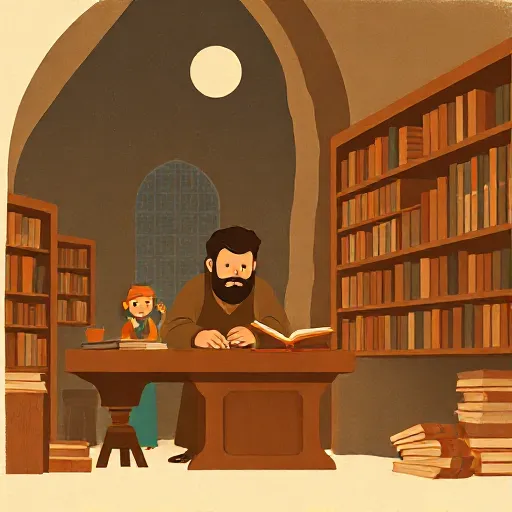
Hunayn ibn Ishaq (809–873) was a doctor from al-Hira, in present-day Iraq. But his greatest passion wasn’t medicine—it was books. Books written centuries earlier in ancient Greek, by thinkers like Aristotle and Plato. Under the hot sun, Hunayn rode from city to city, spending small fortunes to buy old scrolls. Then he sat down and painstakingly translated them into Arabic, the language of the vast Islamic empire ruled by the Abbasid caliphs in Baghdad.
He was not the first to do this. Already under the Umayyad caliphs in Damascus (661–750), some Greek works of advice for rulers and science had been translated into Arabic. After the Abbasids moved the capital to Baghdad in 762, the caliph al-Mansur (r. 754–775) ordered translations of Greek logic. His secretary Ibn al-Muqaffa‘ produced a compendium of Aristotle’s logical works—the first outline of the Organon in Arabic. A generation later, under Harun al-Rashid (r. 786–809), translations of Aristotle’s Physics and other works appeared, though these early versions are now lost.
The real explosion came with al-Ma’mun (r. 813–833). He believed that reason and revelation could work together, and he filled his court with scholars from every faith. He founded the legendary Bayt al-Hikma (House of Wisdom), a library and translation center in Baghdad. Hunayn, the desert doctor, became one of its stars. The whole movement was a deliberate, state-supported project to collect the world’s wisdom. This huge effort is called the Graeco-Arabic translation movement. Over two centuries, it brought almost the entire library of Greek philosophy into Arabic, creating the foundation for falsafa, the Arabic tradition of philosophy that blended Islam with ancient Greek ideas.
When Aristotle Became a Muslim: The Circle of al-Kindi
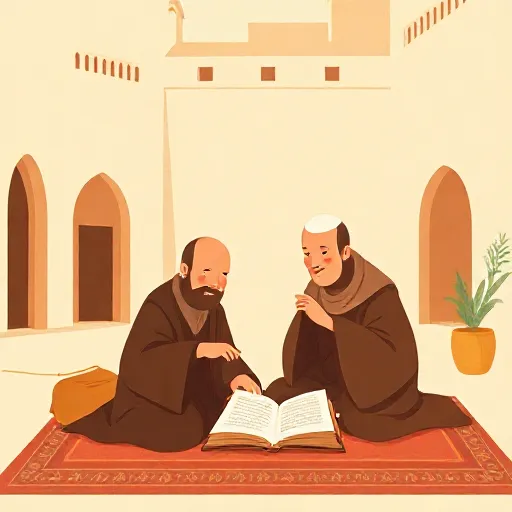
At the court of al-Ma’mun, a brilliant scientist named Abu Yusuf Ya‘qub ibn Ishaq al-Kindi (c. 801–873) gathered a circle of translators. Al-Kindi is often called the first philosopher of the Arabs. He and his team didn’t just translate; they reshaped Greek ideas to fit a new faith.
One of their most astonishing moves was to create a “fake Aristotle.” They took a set of writings by the Greek thinker Plotinus (c. 204–270) and packaged them as a book called the Theology of Aristotle. This work—actually a translation and reworking of parts of Plotinus’s Enneads—pretended to be Aristotle’s final, deepest teaching. It described a universe flowing from a single, perfect source: the One. From the One came a divine mind, or Intellect, and from Intellect came the Soul, which gives life to the world.
Why pretend that Plotinus was Aristotle? Because Aristotle had huge authority. By hiding Plotinus’s ideas under Aristotle’s name, al-Kindi’s circle could present a smooth, unified picture: all Greek wisdom pointed toward one God, just like Islam’s own teaching of tawhid, the absolute oneness of God. They also translated parts of Proclus’s Elements of Theology, another Neoplatonic work, and circulated it under Aristotle’s name. Al-Kindi wrote a book called On First Philosophy, using these Neoplatonic ideas to argue that God creates the world from nothing—creation ex nihilo—and that philosophy proves God’s unity. He wasn’t just translating; he was building a philosophical shield for his faith.
The Great Translators: Hunayn and the Whole Aristotle

While al-Kindi’s team experimented with blending traditions, another group concentrated on getting every single word of Aristotle right. Hunayn ibn Ishaq and his son Ishaq ibn Hunayn (d. 911) led this effort. They were Nestorian Christians who knew both Syriac (the language of many earlier Christian translations) and Arabic.
Hunayn himself translated Aristotle’s Categories and much of the medical work of Galen. His son Ishaq translated the Nicomachean Ethics, Aristotle’s great book on how to live a good life. He also translated the De Anima (On the Soul), which explains how the mind works, and the Metaphysics, Aristotle’s study of being and the first cause of everything. Thanks to them, learned Muslims could now read Aristotle’s complete logical works as well as his physics, his biology, and his cosmology.
They also translated commentaries. For instance, the works of Alexander of Aphrodisias (fl. c. 200 CE), a sharp ancient interpreter of Aristotle, became central. Alexander’s treatise On the Intellect described a cosmic Agent Intellect—a separate, divine intelligence that lights up human minds, enabling them to understand eternal truths. This idea would become one of the most debated concepts in all of Islamic philosophy. By 900, the entire Aristotelian corpus sat in Arabic, ready for thinkers to argue with. The translators had done their job; now the philosophers took over.
How Greek Ideas Fused with Islam

The next generation—above all, the Muslim thinker al-Farabi (c. 870–950) and the Persian Avicenna (Ibn Sina, 980–1037)—used these translations to build grand systems. They didn’t just repeat Aristotle; they merged his ideas with the Neoplatonic picture of the universe as a great chain of being.
In their models, God is the First Cause or the One. God thinks only about Himself, and from this thinking a first intellect emanates. That intellect produces another, and so on, down to the tenth intellect, which is the Agent Intellect that governs our world and illuminates human reason. The heavenly spheres rotate eternally, moved by their desire to imitate God, and their motion causes all the regular patterns we see in nature.
This cosmic order let Muslim philosophers explain creation without denying God’s oneness, and account for miracles and prophecy in a rational framework. The Agent Intellect, for example, explained how prophets could receive divine revelation. For Avicenna, the human soul could, through philosophy and spiritual discipline, rise to a direct connection with the Agent Intellect, achieving a kind of happiness that was divine. Later, Averroes (Ibn Rushd, 1126–1198) in Muslim Spain would argue for a “purer” Aristotle, stripping away some of the Neoplatonic additions. But through all the debates, one conviction held firm. Averroes put it bluntly: “The truth will not contradict the truth.” Philosophy and Islam, he insisted, could never truly be in conflict.
Why This Ancient Library Still Matters Today

The books that Hunayn and his colleagues rescued didn’t stay in Arabic. In the 12th and 13th centuries, scholars in Europe began to translate these same works into Latin. The Metaphysics, the De Anima, and even the pseudo-Aristotelian Theology of Aristotle (known in the West as the Liber de Causis) shaped medieval Christian thought just as they had shaped Islamic thought.
But the deeper lesson is this: philosophy doesn’t belong to one culture. In Baghdad, a Christian doctor and a Muslim caliph joined hands to preserve the wisdom of a pagan Greek who had died over a thousand years earlier. They changed it, argued with it, and made it their own. Ideas that are big enough cross deserts and languages. The next time you hear someone say “knowledge is power” or “follow reason,” you might be hearing an echo of that long-ago translation room, where a scribe dipped his pen and wrote down a thought that refused to die.
Think about it
- If you could translate only one book from an ancient civilization into your own language, what kind of book would you choose and why?
- The translators sometimes changed Greek ideas to fit Islamic beliefs. Is it okay to change a thinker’s ideas if it helps people, or does that betray the truth?
- Imagine you live in a world where all philosophical books are lost except one. Which single question would you most want that book to answer, and why?