
If a Cup Exists, Is That Part of What It Means to Be a Cup?
A Cup, a Horse, and a Big Question

Imagine you’re holding a cup. You can see its shape, feel its weight. Now ask yourself: what makes it a cup? Is it the material, the shape, the job it does? Now ask a stranger question: is being a cup the exact same thing as existing? Can you even separate the two?
For the earliest Islamic philosophers in the falsafa tradition, the answer was simple: no. A thing’s existence just is what it is. Abū Yaʿqūb al-Kindī (died around 870 CE) said that “to be” means “to be something.” A cup exists as a cup, nothing more. His successor, Abū Naṣr al-Fārābī (died 950 CE), came close to pulling them apart but stopped short. He pointed out that when you say “horses exist,” you’re really saying the idea of a horse has real examples outside your mind. That’s a hint that existence might mean something different from horseness. Yet in the end, al-Fārābī still insisted that for a real horse out in the world, its existence is identical to what it is. To be a horse is just to be.
So why did anyone think there was a puzzle here at all? Because another group of thinkers looked at the world and saw a deep gap between what a thing is and the bare fact that it’s there. Their story starts with a bold claim: some things are real even before they exist.
Things That Are Real Before They Exist?
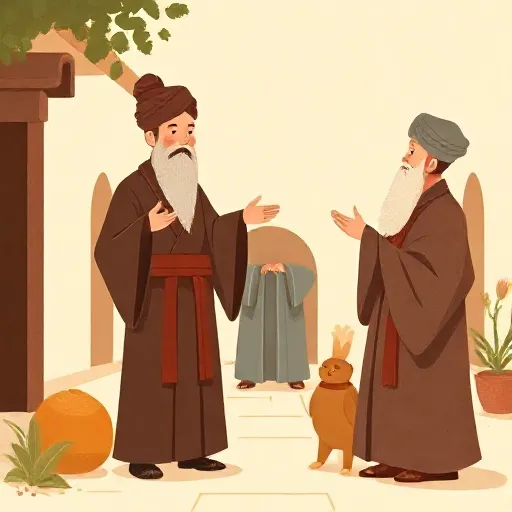
The scholars of kalām — a separate philosophical tradition in the Islamic world — tackled this head-on. The Basran branch of the Muʿtazilite school, active in the ninth and tenth centuries, proposed something startling: non-existent things are still things. Their slogan was “the non-existent is a thing” (al-maʿdūm shayʾ). They meant that before God creates a horse, that horse already has a kind of shadowy reality. God’s job isn’t to decide what a horse is; it’s just to attach existence to an object that was already, in some sense, real.
Why would anyone believe that? The Muʿtazilites pointed to thoughts and wishes. When you wish for a unicorn, your wish must be connected to something — otherwise, what is it about? Even if unicorns don’t exist, they must have some minimal reality to be the target of your thought. The same logic applied to God’s thoughts before creation.
They also developed a theory of states (aḥwāl). A state is a feature that belongs to something but isn’t a separate chunk of reality itself. For example, “occupying space” is a state of a physical object; it’s not an extra ingredient you can point to. The Muʿtazilites said that being existent is exactly such a state — it’s distinct from what an object is, but it isn’t an entity on its own. So existence is something added to things, but not like a second Lego brick.
The Ashʿarite school of kalām fought back fiercely. They denied that anything is real unless it exists. A non-existent thing is just nothing at all. If you think of a unicorn, you’re not connecting to some ghost-realm; you’re just imagining it “on the supposition of its existence,” as one Ashʿarite put it. For them, there is no distinction whatsoever between what a cup is and that it exists. The two are a single package deal.
This clash — between those who saw a real difference and those who didn’t — set the stage for the most famous name in Islamic philosophy.
Avicenna’s Sharp Knife: Separating What from That

Abū ʿAlī ibn Sīnā (died 1037 CE), known in the West as Avicenna, made the distinction between essence and existence the centerpiece of his metaphysics. His weapon was a simple thought experiment. Can you understand what a horse is — its horseness — without having any idea whether horses actually roam the earth? Yes. That, Avicenna said, proves that existence is not built into the essence of a horse. If existence were part of the very definition of “horse,” then doubting a horse’s existence would mean you didn’t understand “horse” at all. Since you obviously can, existence must be something extra.
Avicenna also fought against the idea that “to exist” means something different in every case — that for a cup, existence means “cuplike existence,” and for a horse, “horselike existence.” If that were true, saying “horses exist” would be just saying “horses are horses.” That’s pointless. So existence, he argued, is a single shared meaning, though it can apply more or less perfectly to different things (a God exists more fully than a cup).
Still, Avicenna never went as far as the Muʿtazilites. He did not believe that essences hang around in some ghostly waiting room before creation. For him, nothing has reality without existing — either outside the mind or inside it. When you think of a phoenix, the phoenix you’re thinking of exists in your mind, not in some third realm. So essence and existence are always found together in one concrete being, even though in thought you can pry them apart.
The one exception, Avicenna said, is God. God’s very essence is to exist. God is the Necessary Existent — the only being whose definition demands its existence. For everything else, essence and existence remain distinct, with God giving existence to essences that don’t have it on their own. This neat picture, however, didn’t satisfy the next generations.
After Avicenna: A Fight Over Lego Pieces

If essence and existence are genuinely distinct in reality, like two pieces of a model, you run into trouble fast. Take essence alone, before existence arrives. Is it nonexistent? If so, how can existence attach to nothing? But if the essence already exists in some way, then you’ve just pushed the problem back: now it has a second-order existence, and you can ask the same question about that. The same infinite regress attacks the existence side: if existence is a real thing, does existence itself exist? Then it would need another existence, and so on forever.
These puzzles led most post-Avicennan thinkers to become conceptualists. Shihāb al-Dīn al-Suhrawardī (died 1191 CE) argued that existence is just a concept in our minds, a tool for saying that the idea of a horse corresponds to something out there. There are no “existence” particles floating around; there are only the essences themselves. Asking whether existence exists is like asking whether “being an individual” is an individual — it’s a category mistake.
A smaller group, the realists, tried to save Avicenna’s real distinction. Fakhr al-Dīn al-Rāzī (died 1210 CE) accepted that essences are prior to their existence but insisted this priority is purely logical, not a matter of some shadowy half-existence. Essences, considered just as themselves, are neither existent nor nonexistent — applying those labels misses the point. He even extended this to God: God’s essence, he said, is logically prior to God’s existence and causes it, although in God’s unique case no external cause is needed.
For most later thinkers, however, the conceptualist victory seemed secure. Existence wasn’t a thing; it was a mental note we make about real things. Essences alone are real. But then came a thinker who flipped the whole debate on its head.
Turning the World Inside Out: Existence First

Ṣadr al-Dīn al-Shīrāzī (died 1640 CE), better known as Mullā Ṣadrā, proposed a radical reversal. The conceptualists had said: existence is a concept, essences are real. Mullā Ṣadrā said: no, existence is the only reality. Essences are just the way our minds carve up the world. Outside the mind, there are no distinct “horses” and “cups” as fixed essences — there is only existence itself, a single flowing ocean of being, with different grades and intensities. What we call a horse is just a particular ripple in that ocean.
This is ontological monism: the idea that all of reality shares one existence. Influenced by Sufi thinkers like Ibn ʿArabī (died 1240), Mullā Ṣadrā held that God’s existence is the only existence, and everything else is a manifestation of it. God doesn’t create essences — there are no essences to create. God simply pours out existence into the gradations we see.
The older question of whether God creates what things are now looked entirely different. For Avicenna, God didn’t coin essences; he only gave them existence. For later mainstream Islamic thought, God created both essences and existence. For Mullā Ṣadrā, God creates existence alone. What we call essences are just our human way of labeling the endless variations of existence.
This view transformed Islamic philosophy. It shifted the focus from a world built of fixed natures to a world of dynamic, flowing being. The debate between the primacy of essence (things are fundamentally what they are) and the primacy of existence (things are fundamentally that they are) became the defining question for centuries.
Why It Still Matters

You began with a cup. Now you might look at yourself and wonder: is what you are — your personality, your memories, your humanness — separate from the bare fact that you exist? If you could upload your mind to a computer, would the you-ness transfer, or does existence need a particular biological body?
The Islamic debate over essence and existence is not a dusty museum piece. It shapes how people think about creation, identity, and whether the universe is a collection of separate things or one single reality wearing different masks. Next time you say “I am,” ask yourself whether the “I” and the “am” are two pieces or just one — and whether the answer changes anything at all.
Think about it
- If you could describe every detail of a unicorn but no unicorn exists, what’s missing? Could that missing piece be something like “existence”?
- If everything flows from one single existence, like a giant ocean, are you really a separate person, or just a wave that looks separate for a moment?
- Imagine a perfect clone of you with all the same memories and traits. Would that clone’s existence be different from its “you-ness”? What would make one real and the other a copy?