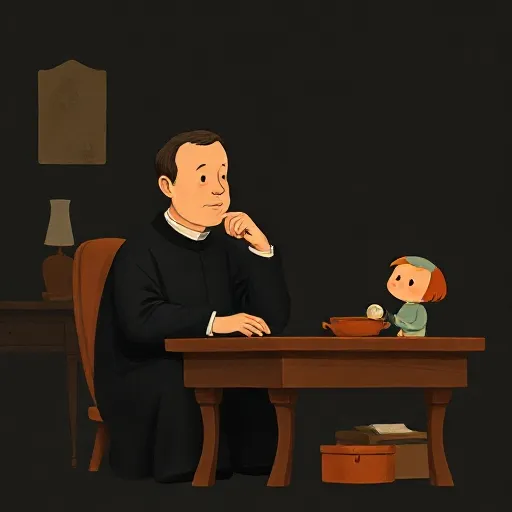
What Do We Really Know? Antonio Rosmini’s Search for the Foundation of All Knowledge
Imagine you’re in a dark room and someone hands you a flashlight. You click it on, and now you can see the furniture, the walls, the door. But you never see the beam of light itself—you only see what it illuminates. Without the beam, everything stays dark and meaningless. With it, the world becomes something you can recognize, name, and move through.
Now imagine that beam of light is inside your own mind, and it’s the only reason you can understand anything at all.
This is the strange idea at the heart of Antonio Rosmini’s philosophy. He thought that every human being is born with a kind of inner light—a basic sense of “being” itself—that makes all thinking possible. Without it, you couldn’t recognize anything as real, not even your own hand. But here’s the twist: that light is not yours. It’s something that shines through you, from somewhere outside your own mind. And figuring out where it comes from, what it means, and how it connects to the world you touch and taste and feel—that’s the project that consumed Rosmini’s entire life.
The Puzzle: How Do We Know Anything at All?
Let’s start with a simple question: How do you know that the book in your hands exists?
The obvious answer is that you can see it, feel it, maybe even smell the paper. Your senses tell you it’s there. But here’s the thing—your senses can be wrong. You’ve probably had the experience of mistaking a shadow for a person, or hearing a sound that wasn’t really there. So sensations, by themselves, aren’t enough to give you certainty.
On the other hand, maybe you know the book exists because you have the idea of a book in your mind, and the physical book matches that idea. But then where did the idea come from? Did you invent it yourself, based on your experiences? If so, we’re back to the problem of unreliable senses.
Philosophers have been fighting about this for thousands of years. Some say all knowledge comes from the senses (they’re called empiricists). Others say true knowledge comes from ideas that are already in your mind before you have any experiences (those are the rationalists). Rosmini thought both sides were half-right and half-wrong. He wanted to find a middle path—one that could explain both how our senses matter and how our minds can know things with certainty.
He started with two simple rules:
First rule: When explaining how the mind works, don’t assume more than you need. Second rule: But also, don’t assume less than you need.
These might sound obvious, but they turned out to be surprisingly powerful. They meant he could reject both the simple answer (“knowledge is just sensations”) and the overly complicated answer (“the mind is full of built-in ideas for everything”). He was looking for exactly one thing—just one—that the mind had to be born with in order for any thinking to happen.
The One Idea That Makes All Other Ideas Possible
What Rosmini found, after a lot of careful thinking, was this: The one thing your mind must already have in order to understand anything is the idea of being.
Not “a specific being” like a tree or a cat or a person. Just being in general—the sheer fact that something is, rather than not being. Before you can recognize anything as a chair, you have to recognize that it exists. Before you can think “this is true” or “this is false,” you have to know what it means for something to be real.
Rosmini called this the innate idea of being. It’s already in your mind from the very first moment you exist, before you’ve learned anything. It’s not something you learn from experience—it’s what makes learning from experience possible in the first place. Like the flashlight beam you never see directly but that lights up everything else.
This idea has some weird properties. It’s universal (it applies to everything that exists). It’s infinite (there’s no boundary to what could exist). It’s necessary (you can’t imagine a world where nothing at all exists). And most importantly, it’s objective—it doesn’t belong to you personally. It shines through your mind, but it comes from somewhere beyond you.
Think of it this way: You don’t invent the rules of mathematics. Two plus two equals four whether you want it to or not. The truth of that equation just presents itself to your mind. Rosmini thought that the idea of being works the same way. It’s a kind of truth that arrives in your mind ready-made, not something you make up.
But here’s an important distinction: This idea of being is not God. It’s not a person, and it’s not all-powerful. It’s more like the possibility of everything that exists—the blueprint for reality, not reality itself. And it acts as the light by which you understand everything else.
How Sensations and Ideas Work Together
If the idea of being is like a flashlight beam, then your senses are like the things the beam falls on. The beam alone doesn’t tell you what’s in the room—for that, you need actual sensations: the feeling of a dog’s fur, the sound of rain, the sight of a red apple. But without the beam, those sensations would be just meaningless blips—you wouldn’t recognize them as experiences of something real.
Here’s how Rosmini thought it worked:
- Your body gives you sensations: colors, sounds, textures, smells.
- Your mind gives you the idea of being: the light that lets you recognize these sensations as real things.
- When the light of being meets a sensation, you form a judgment: “This red thing I see is an apple.” Or just: “This is real.”
- Those first, simple judgments—the ones you make without thinking—cannot be wrong. You know what you know.
But then your mind starts to reflect on those judgments. You compare them, combine them, draw conclusions. And here, Rosmini says, is where error creeps in. Your will—your desire to believe certain things—can push your reason to invent what it doesn’t see or deny what it does. You can talk yourself into believing something false. But your basic, direct perception of reality? That part is trustworthy.
So for Rosmini, certainty is not about never being wrong. It’s about knowing something so clearly that you can’t reasonably doubt it, and being able to give a reason for why you’re sure. You can be certain only of the truth—not of error. If you’re firm about something false, that’s not certainty; it’s just stubbornness.
What Makes a Person a Person?
Okay, so you have a mind that can know things, and a body that gives you sensations. But what are you, really? Are you your body? Your mind? Something else?
Rosmini thought about this carefully. He noticed that when you say “I feel sad” or “I want that” or “I think this is true,” there’s a strange split going on. There’s the feeler—the “I” that experiences—and there’s the felt—the thing being experienced. These are different. The feeler (your soul) is not material; the felt (your body, the world) is material. But together they make up feeling, which is your basic experience of being alive.
Here’s where it gets interesting. Rosmini believed that from the very beginning of your existence, you have a fundamental feeling—a basic, underlying sense of yourself as a living being in an unbounded space. It’s not a thought; it’s more like a constant background hum. All your other feelings—hunger, cold, excitement—happen within this fundamental feeling.
But what makes you a person—not just a living creature that feels things? Rosmini’s answer is your will. Your will is the part of you that chooses what to do based on what your intellect knows. It’s the supreme active principle in you. And because of that, it’s also the source of your dignity.
Here’s what that dignity means: You are never just a thing to be used by someone else. You are an end—a goal in yourself. Nobody has the right to treat you as a mere tool for their purposes. That’s because you share in the light of being, which connects you to something infinite and absolute. To use a person as a means is to violate the truth itself.
How Should We Act?
If your dignity comes from the fact that you know truth and can choose to follow it, then morality is about making that choice. For Rosmini, the basic moral rule is simple:
You are bound to acknowledge what you know for what it is.
In other words, don’t pretend you don’t see the truth you’ve recognized. Don’t lie to yourself. And don’t act as if something false is true just because it’s convenient.
This might sound like just being honest, but Rosmini meant something deeper. He thought that whenever you know something truly—even something simple, like “this apple exists”—you’re in contact with being itself. To deny that knowledge, to act against it, is to step into non-being. It’s a betrayal not just of honesty but of your own nature as a person who lives in the light of truth.
Morality, then, is about aligning your will with the order of being. Moral good happens when you desire things as they really are, in their proper relationships. Moral evil happens when you desire things out of that order—wanting something even though you know it’s wrong, or caring more about your own pleasure than about what’s true.
This also gives Rosmini a way to think about conscience. Your conscience is a judgment you make about whether your own actions are moral or not. And here’s the tricky part: Conscience can be wrong. You can sincerely believe something is right when it isn’t. So the question “Should I always follow my conscience?” has two sides:
- If your conscience tells you something is right, you must follow it. To go against what you believe is the right thing is always wrong.
- But you also have a duty to correct your conscience when it’s mistaken. You can’t just shrug and say “well, that’s what I believe” if you know you haven’t thought carefully.
So the answer is: Follow your conscience, but also make sure your conscience is as accurate as possible. That requires honesty, thinking, and a willingness to learn.
Rights: What You Deserve Because You’re a Person
If every person is an end—never just a means—then every person has rights. Rosmini thought about this more carefully than most philosophers of his time.
He argued that the basis of all rights is simply this: Because you are a person, you have a claim to what is your own—your life, your freedom, the things you’ve honestly acquired. Other people are morally obligated to respect those claims. To violate a right is to violate the person themselves.
Notice the order here: Your rights don’t come from the government. They don’t come from laws. They come from the fact that you’re a person who shares in the light of being. The government’s job is to protect your rights, not to create them. A government that tries to take away your basic rights—that uses you as a tool for some larger plan—is violating what makes society possible in the first place.
But Rosmini also thought that society itself is something good. Humans naturally form families, communities, and nations because we need each other. The purpose of any society is the common good—the well-being of all its members. And that common good includes both virtue (living well) and contentment (being satisfied in a deep, whole-person way). A society that makes its people miserable or forces them to be immoral is failing its own purpose.
Here’s one of Rosmini’s most practical insights: Societies have a kind of life cycle. They begin with founders who focus on the essential principles. Then they develop and grow. Then they become concerned with external splendor—appearances, wealth, power. Finally, they become frivolous, obsessed with trivial things, and unable to handle real problems. At that point, they’re in danger of collapse. The only way to survive is to return to the beginning—to rediscover the core principles that made the society worth belonging to in the first place.
Where Does the Light Come From?
This gets us to the deepest question of all. If the idea of being—that light that makes all understanding possible—is not something you invented, where does it come from?
Rosmini’s answer was that it must come from something that is being itself, fully and completely. Not just the possibility of things, but the actual infinite reality. That something, he thought, is what people call God.
He didn’t think you could see God directly—not with your senses, not even with your mind. But you can reason to God’s existence. Here’s one of his arguments:
- Your mind has the idea of infinite, intelligible being.
- That idea must have been given to you by something that actually has that infinite being.
- Something that actually has infinite being must be God.
- Therefore, God exists.
This is what philosophers call an a priori argument—it starts from a basic idea and reasons forward, rather than starting from evidence in the world and reasoning backward. Rosmini thought these arguments were stronger than the usual ones that begin with the design of the universe or the existence of motion.
But he also admitted a deep limitation: While you can prove that God exists, you can’t perceive God. You can know that God is, but you can’t know what God is like in any direct way. Your concepts of God are always incomplete, like describing a color to someone who has never seen it. This is what makes the whole philosophical project unfinished—and maybe unfinishable.
Why This Still Matters
Rosmini died in 1855, but his questions are still alive. Every time you wonder whether you can trust your own senses, or what makes something true, or why people deserve to be treated with respect, you’re touching the same problems he wrestled with.
His answer—that there’s a light of being in your mind that you didn’t create, that connects you to something beyond yourself—is not the last word. Philosophers still argue about it. But it’s a powerful idea. It means that at the deepest level, you’re not alone in your own head. The truth you seek is not something you invent. It’s something you participate in. And that participation is what makes you a person, with dignity, rights, and a moral call to live honestly.
The flashlight beam is still on. The question is whether you’ll pay attention to what it shows you—even when what you see is difficult, or confusing, or asks something of you.
Appendices
Key Terms
| Term | What It Does in the Debate |
|---|---|
| Idea of being | The built-in, universal light in your mind that lets you recognize anything as real |
| Innate | Present from birth, not learned from experience |
| Objective | True for everyone, not just your personal opinion |
| Fundamental feeling | The basic, constant sense of yourself as alive in space, underneath all your other feelings |
| Person | A being with intellect and will, who can know truth and choose to follow it—never just a tool |
| Will | The part of you that chooses what to do; the source of your dignity as a person |
| Moral good | Choosing what is actually good according to the real order of being |
| Conscience | Your judgment about whether your own actions are moral or not (can be wrong) |
| Right | A claim you have to what is your own, based on being a person, that others must respect |
| A priori | Reasoning that starts from a basic idea rather than from evidence gathered by the senses |
Key People
- Antonio Rosmini (1797–1855): An Italian priest and philosopher who was kicked around by both his admirers and his opponents—some of his books were banned by the Catholic Church, then un-banned 150 years later. He argued that all knowledge depends on an innate idea of being.
- John Locke (1632–1704): An English philosopher who said all ideas come from experience and the mind starts blank. Rosmini thought this couldn’t explain how we understand anything at all.
- Immanuel Kant (1724–1804): A German philosopher who argued that the mind shapes reality with its own categories. Rosmini thought he went too far—adding more built-in ideas than necessary.
Things to Think About
-
Rosmini says your first, direct perceptions of reality cannot be wrong—only your reflections on them can. Think of a time you were absolutely certain about something simple (like “that dog is barking”) and later found out you were mistaken. Was your original perception wrong, or was it something else? Where exactly did the error begin?
-
If the idea of being is universal and objective—the same for everyone everywhere—then why do people disagree so much about what’s real and what’s true? Does Rosmini have a good explanation for this, or does it point to a problem in his theory?
-
Rosmini says you must always follow your conscience but also must correct your conscience when it’s wrong. How do you know which conscience to follow while you’re in the middle of correcting it? Is there a way out of this loop?
-
If every person is an end and never just a means, does that mean you can never use anyone for anything? What about a soccer coach who makes players run drills—is the coach using the players as means to win games? Where’s the line?
Where This Shows Up
- In debates about human rights: The idea that rights come from being a person, not from governments, is the foundation of the Universal Declaration of Human Rights (1948). Rosmini’s version of this argument was especially influential in Catholic thinking about social justice.
- In arguments about artificial intelligence: If the “light of being” is what makes understanding possible, could a computer ever really think? Rosmini’s answer would be no—because computers don’t have an innate intuition of being. This puts him in the middle of a very modern debate.
- In every conversation about lying and truthfulness: Rosmini’s idea that you’re bound to acknowledge what you know is basically the foundation of honesty. When someone says “I had to lie because the truth would hurt,” they’re making a choice Rosmini would say is impossible to justify.
- In the question of whether democracy works: Rosmini thought that one person, one vote wasn’t automatically fair—he wanted the system to reflect people’s actual contributions. That’s a minority view today, but it raises a real question about what justice in voting really means.