Do Animals Know What Others Are Thinking?
You’re walking through a park and see a squirrel freeze, then dart up a tree. You look around and spot a dog heading toward the base of the tree. The squirrel, you figure, saw the dog and got scared. You just explained the squirrel’s behavior by guessing what it perceived and felt—you attributed mental states to another animal without thinking twice about it.
But did the squirrel really see the dog and feel fear? Or did it just react automatically to a moving shape? And does it matter whether we’re right about the squirrel, if our explanation works well enough?
For the last fifty years, scientists and philosophers have been arguing about a surprisingly slippery question: Do non-human animals understand what others are thinking, feeling, or seeing? Not just whether they react to what other animals do—but whether they actually think about what’s going on inside other minds.
What Would It Take to Prove an Animal Has a “Theory of Mind”?
In 1978, two primatologists named David Premack and Guy Woodruff published an article with a bold title: “Does the chimpanzee have a theory of mind?” By “theory of mind,” they meant the ability to attribute mental states—like beliefs, desires, intentions, and knowledge—to yourself and others. They thought this ability was like a theory because you can’t directly observe someone else’s mental states; you have to infer them from behavior, just like a scientist infers invisible causes from visible effects.
Premack and Woodruff ran experiments with a chimpanzee named Sarah. They showed her videos of a person struggling with problems (like being cold because a heater wasn’t working) and then gave her a choice of photos showing possible solutions (a lit match, a blanket). Sarah usually picked the correct solution, suggesting she understood what the person wanted or needed.
But three philosophers—Daniel Dennett, Jonathan Bennett, and Gilbert Harman—each pointed out a problem. If the observing animal and the target animal share the same mental states (like both knowing where food is hidden), then the observer could just use its own knowledge to predict the other’s behavior. No need to think about the other’s mind at all. To really prove an animal attributes mental states, the philosophers argued, you need a situation where the observer’s mental states and the target’s mental states are different—where there’s a divergence.
Their solution? False beliefs.
The False Belief Test
If you believe something that isn’t true, your behavior will be based on that false belief. If another animal can predict your behavior even though they know the truth, that’s strong evidence they understand your belief is different from theirs.
For human children, this is tested with the classic “Sally-Anne” scenario: Sally puts a marble in a basket and leaves. While she’s gone, Anne moves the marble to a box. When Sally returns, where will she look for the marble? Children under about four years old usually say “the box”—they can’t separate what they know from what Sally knows. Around age four to six, children start saying “the basket,” showing they understand Sally has a false belief.
Translating this test to animals is incredibly hard, because you can’t just ask them where they expect Sally to look. For decades, researchers struggled to design experiments that would show whether animals understand false beliefs without relying on language.
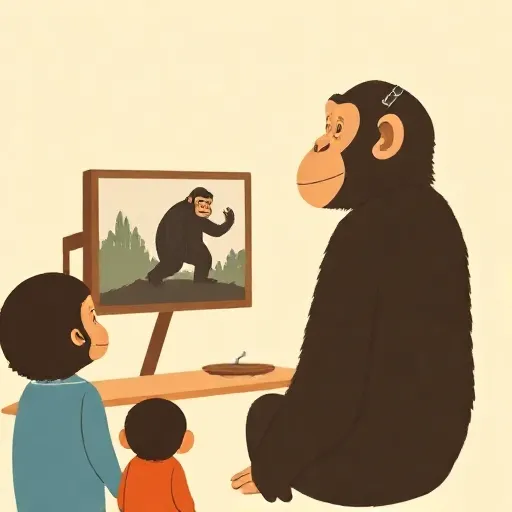
In 2016, a team led by Christopher Krupenye tried a clever approach using eye-tracking. They showed chimpanzees, bonobos, and orangutans videos of a person in a King Kong costume hiding from another person. In one condition, King Kong hid in a haystack while the human was watching, then secretly moved to another haystack while the human’s back was turned. When the human returned, the apes’ eyes tracked to the haystack where the human falsely believed King Kong was hiding—not where he actually was. This suggested the apes anticipated the human would act on his false belief.
But here’s the thing: some researchers still weren’t convinced. They argued the apes might just be tracking where the human last saw King Kong, without actually understanding anything about beliefs. And in the years since, some of the similar studies with human infants have failed to replicate, making researchers wonder whether the original results were reliable.
The “Logical Problem”
This disagreement points to what’s called the “logical problem” in animal social cognition research. The problem is simple to state but hard to solve: whenever an animal seems to understand what another animal is thinking, it could instead just be tracking observable cues—like where the other animal is looking, what direction its head is pointing, or recent patterns of behavior.
Imagine a chimpanzee named Max who watches a dominant chimp, Bella, see food placed behind a barrier. Then Bella is distracted, and while she’s not looking, the food is moved. When Bella returns, Max expects her to look behind the original barrier. Does Max understand that Bella has a false belief? Or does he just know that Bella’s line of gaze last pointed behind the barrier, and is predicting she’ll go where she was looking?
This is the core of the dispute. Skeptics say animals are sophisticated “behavior-readers”—they track observable cues with impressive skill, but they never really think about what’s going on inside another mind. Proponents say that when behavior-reading gets complex enough, it starts to look a lot like reading minds, and it’s arbitrary to draw a sharp line.
The philosopher Robert Lurz proposed an experiment to overcome this problem. The idea: teach chimpanzees that one color of goggles lets you see through them, while another color blocks vision. The chimpanzees would learn this from their own experience. Then, in a test, they’d see another chimpanzee wearing one color or the other. If they could figure out whether the other chimp could see, based on their own experience with the goggles, that would suggest they weren’t just tracking gaze cues—they were projecting their own perceptual experience onto another.
Some experiments using this basic logic have shown positive results, with chimpanzees and even ravens passing versions of the test. But skeptics still find problems, arguing the animals might just be responding to learned associations.
Maybe There Are Different Kinds of Mindreading
This impasse has led many philosophers to wonder whether the whole debate is set up wrong. Perhaps there isn’t just one thing called “theory of mind”—perhaps there are different systems for understanding others, some shared with animals and some uniquely human.
Philosophers Ian Apperly and Stephen Butterfill proposed that humans might have a “minimal theory of mind” system. This system tracks what they call “registrations”—basically, records of what others have seen or not seen. A registration isn’t a full-blown belief; it’s more like a mental sticky note saying “Agent X last saw Object Y at Location Z.” This system could explain why animals sometimes pass false-belief-like tests without actually having a concept of belief. The full human system, which handles abstract reasoning about beliefs and can think about what others think about what we think, would be unique to humans.
Other philosophers have suggested that maybe social cognition isn’t about forming theories at all. Maybe it’s more like simulation—you use your own mind as a model, imagining what you would think or feel in the other’s situation. Or maybe animals directly perceive certain mental states in others, like you can see that someone is angry without having to infer it.
So What’s the Answer?
After decades of research, there’s no clear winner. The evidence suggests many animals—especially apes, corvids (crows and ravens), and dogs—can track what others see, know, and want in surprisingly flexible ways. They seem to understand things like: “Bella saw the food go behind that barrier, so she thinks it’s still there.” But whether this counts as really understanding mental states, or just tracking observable cues in sophisticated ways, is still hotly debated.
This part gets complicated, but here’s what the disagreement comes down to: nobody can agree on what counts as proof. Some researchers set the bar very high—they want to see evidence that animals can think about unobservable mental states independently of any behavioral cues. But since humans also can’t read minds directly (we all use behavioral cues), this might set an impossible standard. Other researchers set the bar lower, arguing that if an animal’s behavior can’t be explained any other way, we should accept they’re thinking about minds.
The philosopher Cameron Buckner has suggested the real problem isn’t about animals at all—it’s about what counts as representing something. When does tracking a cue (like a line of gaze) become representing a mental state (like seeing)? This is a deep question in philosophy of mind, and until it’s settled, the animal debate may not be either.
Why This Matters
This debate isn’t just academic. If many animals can think about what others are thinking, that changes how we should treat them. It raises questions about animal welfare, moral status, and whether animals can have rights. If a chimpanzee can understand that another chimp believes something false, that suggests a level of social awareness that might matter for how we keep them in zoos or research facilities.
It also tells us something about ourselves. Humans have a remarkable ability to think about other minds—it’s how we cooperate, deceive, teach, and build complex societies. By studying animals, we can ask whether this ability is uniquely human, or whether it evolved gradually across many species. If corvids can pass some of the same tests as chimpanzees, it might mean complex social thinking evolved multiple times, in different lineages, for similar reasons.
The philosopher Elliott Sober has pointed out that how you approach this question depends on your starting assumptions. If you assume humans are special and unique, you’ll demand very strong evidence before accepting animals have theory of mind. If you assume we’re part of a continuum with other animals, you’ll be more willing to interpret similar behaviors as coming from similar mental processes. Neither assumption is provably right or wrong—they’re starting points that shape how you see the evidence.
Where the Debate Stands Today
Research on animal social cognition has broadened beyond the focus on theory of mind. Scientists now study whether animals understand emotions (ravens seem to console each other after fights), whether they can track others’ desires (scrub jays bring their mates food they prefer, even when the jays themselves prefer something else), and whether they engage in anything like moral behavior.
Some researchers are looking for “signature limits”—patterns of failure that would reveal whether animals use a simple registration-tracking system or a full theory of mind. Others are studying wild animals in natural settings, where they might show abilities that don’t appear in artificial lab experiments.
The big picture is messy, and that’s exactly what makes it interesting. There probably isn’t a single answer to “Do animals have theory of mind?”—because there isn’t a single thing called theory of mind. Different animals probably understand different things about other minds in different ways. A chimpanzee might grasp that another chimp sees something, but not that it believes something. A raven might know what another raven wants, but not what it thinks.
The question might not be “Do animals have theory of mind?” but rather “What forms of social understanding are possible without language, and how do they relate to the forms we humans have?” That question is still wide open, and philosophers and scientists are still arguing about it—which is exactly how it should be.
Appendices
Key Terms
| Term | What it does in this debate |
|---|---|
| Theory of mind | The ability to attribute mental states (beliefs, desires, knowledge) to yourself and others, and to predict behavior based on those attributions |
| False belief test | A test that checks whether someone can understand that another person believes something that isn’t true; considered the gold standard for theory of mind |
| Logical problem | The challenge that any experiment about animal mindreading can be explained by the animal just tracking observable cues (like gaze direction) instead of actually thinking about mental states |
| Behavior-reading | Tracking and responding to observable cues from other animals (where they’re looking, what they’ve done before) without attributing any mental states |
| Mindreading | Attributing mental states to others; the same as theory of mind, but sometimes used to emphasize that it’s not necessarily “theory-like” |
| Minimal theory of mind | A proposed simpler system that tracks “registrations” (what others have seen) rather than full beliefs; may be shared with animals |
| Line-of-gaze cue | A visible indicator of where another animal is looking; the main behavioral cue skeptics argue animals use instead of mindreading |
| Ecological validity | Whether an experiment reflects the animal’s natural environment and challenges; some researchers argue animals only show social abilities in situations that matter to them |
Key People
- David Premack and Guy Woodruff — The primatologists who kicked off the modern debate with their 1978 paper asking whether chimpanzees have theory of mind
- Daniel Dennett — A philosopher who argued that false belief tests are the best way to prove animals think about other minds
- Daniel Povinelli — Started as a believer in chimpanzee theory of mind, then became one of its most skeptical critics after his experiments kept showing negative results
- Brian Hare and Michael Tomasello — Researchers who designed the competitive food experiment showing that subordinate chimpanzees seem to understand what dominant chimps can and cannot see
- Robert Lurz — A philosopher who proposed the “goggles” experiment design to get around the logical problem
- Christopher Krupenye — Led the 2016 eye-tracking study that suggested apes can anticipate false beliefs
- Susana Monsó — A philosopher who argues animals might have empathetic emotions and even moral cognition without full theory of mind
Things to Think About
-
Imagine you’re a scientist studying whether dogs understand what their owners see. You put food under one of two cups while your dog watches, then have one person leave the room and another person hide the food somewhere else. When the first person returns, does your dog expect them to check the cup where they think the food is? How would you test this without using words?
-
The logical problem says animals might just be tracking behavioral cues, not mental states. But humans also track behavioral cues—we can’t read minds directly. So what’s the difference between “sophisticated behavior-reading” and “mindreading”? Is there a clear line, or is it a matter of degree?
-
Some researchers argue that experiments in artificial lab settings don’t show what animals are capable of, because they lack ecological validity. Other researchers argue that natural settings introduce too many confounds. If you were designing an experiment about chimpanzee social understanding, how would you balance these two concerns?
-
Suppose we discovered that chimpanzees can pass false belief tests. Would that mean they deserve different moral treatment? What if they fail every test—would that mean they don’t deserve moral consideration at all?
Where This Shows Up
- Animal welfare debates — How we keep animals in zoos, farms, and research facilities depends partly on what we think they’re capable of understanding about other minds and their own situations
- Dog training — Many professional trainers work with the idea that dogs understand human attention and intentions, even if the scientific debate isn’t settled
- Artificial intelligence — AI researchers building social robots are interested in “machine theory of mind,” and some recent neural networks have passed animal-style false belief tests, raising questions about what counts as “understanding”
- Conservation — Understanding how animals think about each other can matter for conservation decisions, like whether to release captive animals into the wild or how to manage social species