Can a Monkey Mean “Leopard!”?
A Scream That Means “Snake!”
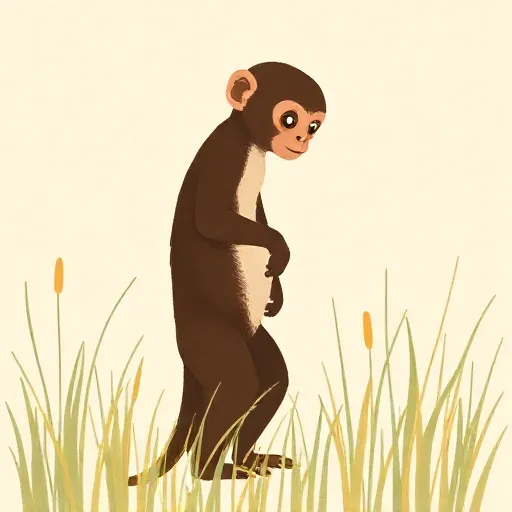
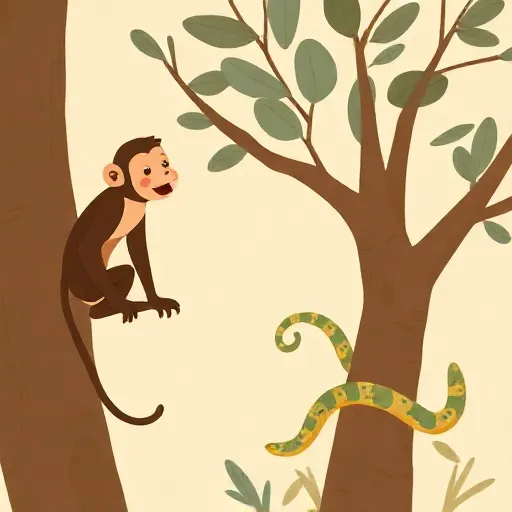
Vervet monkeys in East Africa live in groups and face deadly predators. When a leopard slinks through the brush, a monkey will let out a short, sharp bark. When an eagle circles above, it gives a different, raspy cough. And when it spots a python, the call is a low, chattering sound. Each cry makes the troop react in a way that fits the danger. A leopard call sends monkeys scrambling up into the thinnest, highest branches where a big cat can’t follow. An eagle call makes them look skyward and bolt into dense bushes. A snake call causes them to stand on two legs and stare at the ground, as if searching for a serpent.
Do those sounds work like words? A word like “leopard” points to something in the world. The vervets’ calls seem to do the same thing—each one matches a different kind of trouble, and hearers behave as if they grasp that difference. But many scientists have wondered: are the monkeys actually meaning anything, or are they just blurting out feelings the way a human might scream when she is scared?
Philosophers and animal researchers call signals that seem to point to things functionally referential calls. The idea was introduced by Peter Marler, Christopher Evans, and Marc Hauser in 1992. A functionally referential signal acts as if it refers, even if we can’t tell what is going on inside the animal’s mind. Early versions of this theory said a call qualifies when it is stimulus‑specific—produced only when that specific thing is around—and context‑independent—the same call makes hearers do the same escape move no matter what else they see.
Vervet monkeys looked like the perfect case. But that neat picture soon got messier.
Words Without a Speaker’s Intention?
Researchers Brandon Wheeler and Julia Fischer pointed out that alarm calls in the real world are rarely as tidy as the textbook story suggests. Vervets sometimes make eagle calls when a tree crashes down or when baboons fight nearby. The calls are not fully stimulus‑specific. And receivers do pay attention to context: a monkey who hears an eagle call while it is already hiding in a bush will behave differently from one who hears the same call while out in the open. The response is not truly context‑independent.
Wheeler and Fischer also stressed that many alarm calls are not produced voluntarily. They can be more like a human cry of pain—automatic and hard to hold back. If the calls are just built‑in reflexes, they might not serve as good evolutionary ancestors for words, which we choose to say.
Andrea Scarantino defended functional reference by loosening the old rules. He argued that even human words often break the strict definitions. Words like “I” and “today” are not stimulus‑specific (you can say “today” on any day), and their meaning depends on context. Yet no one doubts that they refer. Scarantino proposed that a signal functionally refers if it is statistically correlated with something and if receivers have learned to act on that correlation using any available contextual clues. On his view, an eagle call carries information about eagles because hearing it raises the probability that an eagle is near—a kind of natural meaning, like smoke meaning fire. The debate over whether these calls are truly word‑like continues.
When Kanzi Says “Apple”
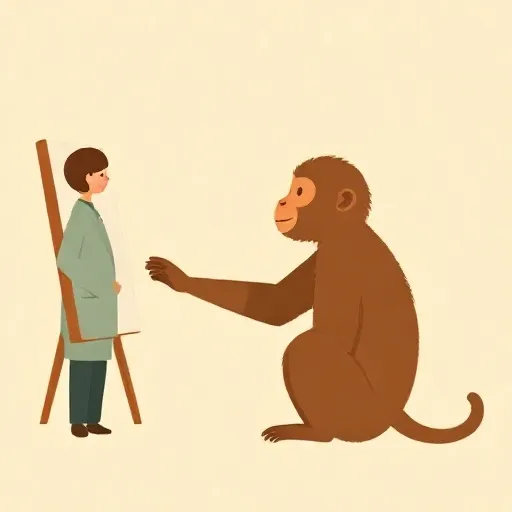
Some animals go far beyond alarm calls. Kanzi, a bonobo raised by researchers led by Sue Savage‑Rumbaugh starting in the 1980s, was not formally taught words. He learned them by watching humans try to teach his adoptive mother. By adulthood he understood hundreds of spoken English words and used a keyboard of about 450 abstract symbols, called lexigrams, to ask for things and answer questions. Apes like Kanzi raise a deep question: can an animal truly know the meaning of a word?
Some linguists say no. Noam Chomsky and Robert Berwick argue that human words are linked to human‑style concepts. They claim that chimpanzees don’t have the right kind of conceptual system, so they can’t map a sign to a concept in the way we do. They point to Nim, a chimpanzee trained in sign language, who sometimes signed “apple” when he saw the knife that was used to slice apples. If Nim just had a bundle of loose associations—knife, drawer, apple—then he didn’t grasp the word the way a child does.
Other philosophers counter that knowing a word’s meaning is mostly about knowing how to use it. The philosopher Ludwig Wittgenstein famously said that for a large class of cases, “the meaning of a word is its use in the language.” On that view, if Kanzi uses a lexigram reliably to get a banana or to describe something he sees, he knows its meaning. The fact that Nim signed “apple” at the sight of a knife could simply mean he was hungry and requesting one—not that he was confused.
A third approach comes from the philosopher Paul Grice. He argued that true communication happens when a sender intends to produce a response in a receiver and also intends that the receiver recognize that first intention. This is called Gricean communication. Many scientists once thought this required such complicated thinking about other people’s thoughts that no animal could manage it. But some philosophers, like Richard Moore, argue that simple behaviors like mutual eye contact can make intentions public enough, without needing towering mental stacks of “I think that you think that I think…”. Whether apes are Gricean communicators is still hotly debated.
Birds That Combine Calls Like Sentences
Human language doesn’t just use words—it builds sentences. We combine small meaningful units into larger structures using rules. The most important rule, some linguists say, is Merge, an operation that takes two items and creates a new, hierarchically organized unit. Merge can be applied again and again, which is why we can say “the very old house” or keep adding “and…” to make any sentence longer. Hierarchical structure means that words group together in ways that aren’t just left‑to‑right: in “very old house,” “very” modifies “old,” not “house.” This ability to endlessly build and nest structures is thought by many to be uniquely human.
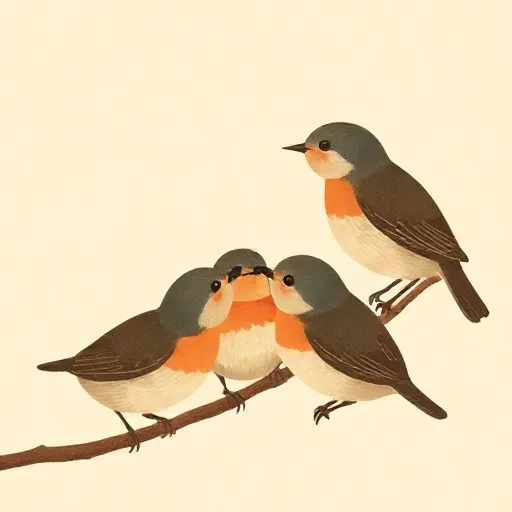
Yet some birds do surprising things. Japanese tits have an “ABC” call that means something like “threat!” and a “D” call that means “come here.” When they string them as “ABC‑D,” it triggers mobbing: other tits gather and scan for a predator. They do not react the same way to a reversed, artificial “D‑ABC” sequence, which suggests they are sensitive to call order. Researchers call this compositional syntax: the meaning of the whole depends on the meanings of its parts.
But is it really syntax like ours? Skeptics say no, because the birds’ combinations are not hierarchical and are not unbounded. There is no evidence that a tit can embed one combination inside another to make a longer, more complex message. Some scientists, like Philippe Schlenker, argue that bird sequences can be explained by simple pragmatic rules: for instance, if a threat‑related call must come first, then hearing it later signals something non‑threatening. That might be clever, but it isn’t grammar.
The most impressive comprehension data come from Kanzi himself. He could tell the difference between “Put the tomato in the oil” and “Put some oil in the tomato.” Yet he struggled with a command like “Fetch the tomato and the oil,” often bringing only one item. This suggests he tracked word order but could not hold two words together under a single verb—the kind of hierarchical grouping that human syntax requires. One study of a bottlenose dolphin did find that it could learn a non‑linear artificial language (phrases like “to the ball, the hoop fetch” rather than “fetch the hoop to the ball”). But it is just one study, and firm conclusions are still out of reach.
Why Share If It Costs You?
A lot of animal communication can be explained by signalling theory. In this framework, senders and receivers evolve together like two halves of a lock and key. A peacock’s heavy tail is an honest signal of health because only a strong bird can afford the cost. A tiger’s deep scratch marks on a tree trunk honestly advertise its size. Signalling systems can be stable even without friendly intentions.
But human communication seems different. Michael Tomasello argues that humans are cooperatively communicative in two ways. First, we often share information just to help others, not to get something for ourselves. Second, our conversations are a kind of joint action where both parties willingly work together to make meaning. Tomasello thought that helpful communication was extremely rare in the animal world. Chimpanzees, he claimed, mostly request things and rarely point out food simply to be informative.
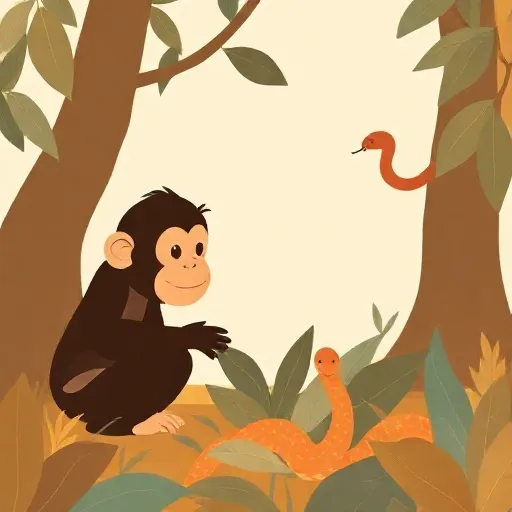
More recent fieldwork has complicated that picture. Catherine Crockford and colleagues documented wild chimpanzees giving alarm calls to warn groupmates about a sleeping snake—especially when the other chimp had not seen it. This looks like voluntary, helpful informing. Dogs, too, are brilliant at understanding human pointing, likely because they were bred alongside us for thousands of years. The line between selfish signalling and cooperative sharing turns out to be blurrier than it once seemed.
What This Means for You
You might never hear a vervet monkey’s alarm call in person, but the questions studied in animal communication touch your life. Scientists are now using artificial intelligence to spot patterns in the sounds of dolphins, whales, and even chickens. If we could decode those signals, we might improve the lives of pets, livestock, and wild animals—understanding when they are stressed, playful, or in pain. And the search for the origins of language is really a search for what makes human minds unique. Every time you say a sentence you invent on the spot, you are using a power that may be shared to only a tiny degree with other creatures. Whether birds have grammar and apes have words are not settled questions—they are live, exciting puzzles, and the answers will shape how we see the world and our place in it.
Think about it
- If a pet parrot learned to say “I’m sad” but only after you gave it a treat, would you say it understands sadness? Why or why not?
- Imagine a device that could translate dolphin clicks into English. If it showed dolphins tell jokes, would that prove they have a language like ours? What else would you want to find out?
- Scientists often study apes because they are our close relatives. Could we learn just as much about language by studying birds or dolphins? What might we miss?