Is Anything Really New? Anaxagoras and the Secret of Change
Snow That’s Black? A Strange Claim in Ancient Athens
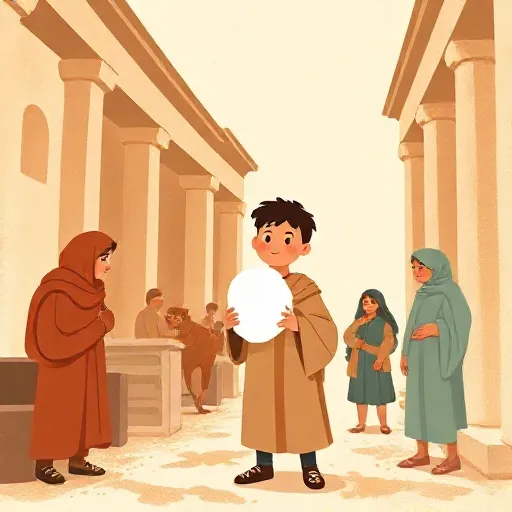
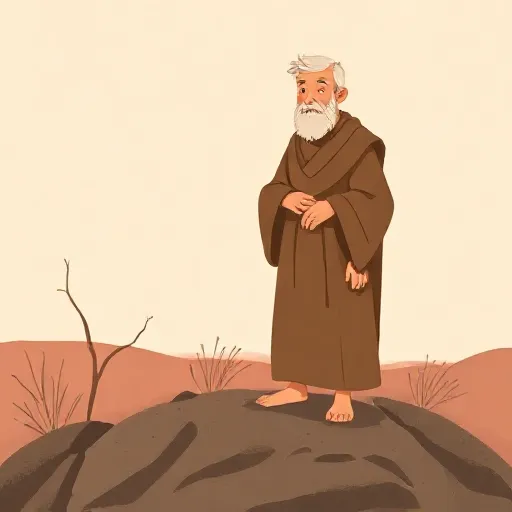
In a busy Athens marketplace, a man scooped up a handful of snow. People nearby expected him to admire its whiteness. Instead he said, “Snow is black.” The crowd must have thought he was joking — or crazy. But for Anaxagoras (about 500–428 BCE), it was a serious claim. He believed that our senses can mislead us, and that the deepest truth about how things change is stranger than it looks.
Anaxagoras was born in Clazomenae, a Greek city on the coast of what is now Turkey. He left his family’s land to study philosophy and eventually moved to Athens, where he became a friend and teacher of the famous leader Pericles. He was one of the first thinkers to bring scientific philosophy to the city. Playwrights like Euripides read his book, and the comic writer Aristophanes poked fun at his ideas on stage. But his closeness to Pericles also made him enemies. Later in life, Anaxagoras was put on trial for “impiety” — partly a political attack — and had to leave Athens. He retreated to Lampsacus, where he was honored until his death.
What would make someone claim that snow is black? Anaxagoras was wrestling with a giant puzzle that had been passed down from an earlier philosopher: Can anything really begin or end?
The Rule That Change Is Impossible

Before Anaxagoras, Parmenides of Elea had argued that true coming-to-be and passing-away are impossible. You cannot go from nothing to something, or from something to nothing. If you say a cake “comes to be” when you mix flour, eggs, and honey, you are cheating: those ingredients already existed. If you say the cake “passes away” when you eat it, you are cheating again — its pieces are still in your body, just rearranged. Parmenides concluded that real change is an illusion, and reality must be one unchanging whole.
Anaxagoras took this challenge seriously. He accepted the rule — let’s call it No Becoming — but he did not want to give up on explaining the world we see. His solution was a two-layer picture of reality. There are basic ingredients (like hot, cold, wet, dry, flesh, bone, dark, bright) that are eternal and never change. Then there are ordinary objects — trees, chairs, people, stars — that are just temporary mixtures of those ingredients. A cake is not a new thing; it is a natural construct, an arrangement of flour, egg, and honey that happens to hold a certain shape for a while. When it crumbles or is digested, the ingredients separate and get mixed into other things. Nothing truly begins or ends.
This two-level metaphysics let Anaxagoras say that change is real enough for everyday life, but deep down nothing new ever appears. The ingredients are the only things that are fully real, because they always are what they are.
Everything Is in Everything (Yes, Even in Your Cereal)

If the cake is just a rearrangement, why does it look and taste like cake rather than raw flour? Anaxagoras had a surprising answer: Everything is in everything. At every spot in the universe, there is a tiny share of every ingredient. In the bread you eat, there is already flesh, blood, and bone — just in such small amounts that you cannot detect them. When you grow, your body gathers those ingredients from food and concentrates them. You don’t turn bread into flesh; you sift the flesh that was already there out of the bread.
Anaxagoras extended this idea to every quality. Warm coffee contains cold, white paint contains black, and light objects contain heaviness. There is no pure anything, only mixtures where one ingredient predominates. This leads to another rule: No Smallest or Largest. No ingredient can ever be completely removed from a mixture. You can make a liquid sweeter and sweeter, but there will always be a trace of sourness. You can make it more and more sour, but it will never be pure sour. Imagine salt dissolved in water. Even if you cannot taste it, there is still salt in every drop — you could, in principle, keep evaporating and never reach a “last salt particle” because there is no smallest amount. The mixture is like a smoothie that never fully separates into single fruits.
This also explains why Anaxagoras said snow is black. Water, he believed, is actually dark. Snow is frozen water, so deep down it contains that darkness, even though the bright appearance of the frozen mixture overwhelms it. Our senses report what predominates, not the hidden ingredients.
The Mind That Spins the Whole Universe
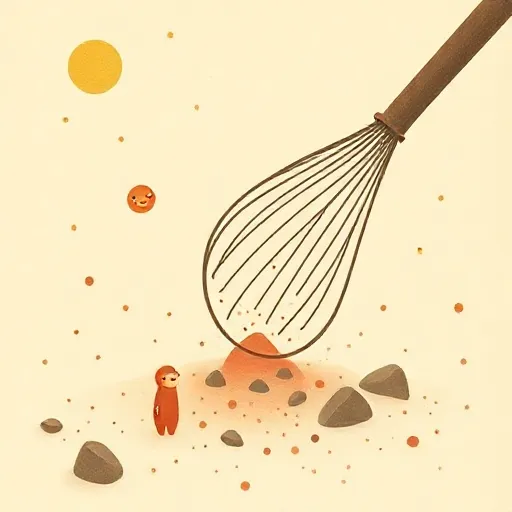
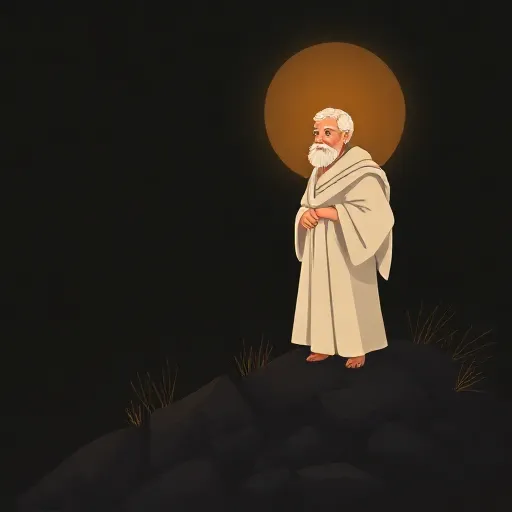
If everything is a mixture, how did the orderly cosmos we see — with earth, oceans, stars, and people — ever arise from a uniform blend? Anaxagoras pointed to nous (Mind, or Intellect). Nous is not an ingredient; it is completely different from everything else. It does not mix with the other things. It is pure, all-knowing, and the most powerful thing there is.
In the beginning, all ingredients were together in a motionless, unlimited mass. Then nous set a small region spinning. That rotation spread outward, like a giant whisk stirring the mixture. As the vortex grew, it separated the ingredients — not completely (because of No Smallest), but enough to create regions where some ingredients predominated. Heavy, dark ingredients like earth clumped toward the center. Light, bright ingredients like fire and aether were thrown outward. Thus the flat earth, covered in part by water, formed in the middle, while the fiery sun, moon, and stars took shape at the edges.
Anaxagoras called this process separating off and mixing together, and he thought it continued forever. The rotation also explained why the sun is a mass of hot metal, why the moon is earthy and has no light of its own, and why eclipses happen when another body passes in front. He became famous for predicting a meteor fall at Aegospotami — a chunk of rock torn from the earth and flung around by the cosmic whirl.
Socrates, who heard Anaxagoras’s book read aloud, was thrilled by the idea of Mind controlling everything. But he was disappointed. Anaxagoras talked about Mind starting the spin, but then explained everything else by mechanical pushes and whirls — not by purpose or what is best. Socrates wanted the universe to unfold for a reason. Anaxagoras gave him a cosmic mechanism with a smart starting point, not a grand plan.
From Meteors to Hail: A Universe Explained Without Gods
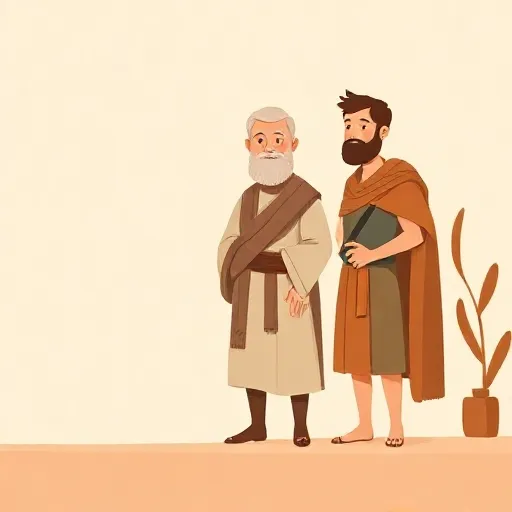
Anaxagoras applied his theory to everything he could. Thunder and lightning? Clashing masses of ingredients. Earthquakes? Air trapped under the earth, forced out by the rotation. The Nile’s floods? Melting snow from southern mountains (a correct guess, controversial at the time). Hail? Frozen rain pushed high by winds. He even offered a startling suggestion about other worlds. In fragment B4a, he wrote that “there are cities that have been constructed by humans and works made, just as with us, and that there are a sun and a moon and other heavenly bodies for them.” The expanding whirl, he thought, might create other systems like ours elsewhere in the unlimited mass — not just one planet, but many, all governed by the same mixing laws.
This drive to find natural explanations for everything made Anaxagoras a hero to some and a threat to others. Pericles, who learned from him, was said to have shed superstitious fear and faced celestial events with calm reason. The playwright Euripides echoed Anaxagorean ideas about mind in his dramas. But the official charge of impiety shows that not everyone welcomed a world where the sun is just hot metal, not a god. His trial was probably more about attacking Pericles through his friends, but the accusation stuck.
Later philosophers, including Democritus and Aristotle, borrowed and criticized his ideas. Aristotle admired Anaxagoras for introducing Mind as a cause, even if he thought the full promise was never delivered. The notion that the cosmos is intelligible — that you can study it with your own mind — owes a lot to this one thinker.
Why It Matters: You Are a Walking Mixture

You might never look at a glass of water the same way. If Anaxagoras is right, every sip you take contains tiny shares of everything — starlight, bone, gold, and cold. The cookie you just ate isn’t gone; its ingredients are rearranging inside you. Change is not destruction, just endless remixing.
But a big question remains: if you are just a temporary arrangement of ingredients that have always existed, what makes you you? Anaxagoras would point to the mixture’s structure and to the presence of nous — a bit of that pure Mind in living things. Your thoughts are not simply rearranged particles; they are something finer. Yet he never fully explained how Mind connects to matter. That puzzle — the relationship between physical stuff and consciousness — is still debated by scientists and philosophers today.
Anaxagoras gave us a universe that can be understood without magic. Every pattern, from a cookie recipe to a galaxy, can be traced back to ingredients and motion. And he did it while refusing to believe that anything truly comes from nothing. Next time you watch a snowflake melt, you might wonder: is it really disappearing, or just slipping into a new mixture, carrying the dark heart Anaxagoras said it always had?
Think about it
- If every “new” thing is just a rearrangement of old ingredients, can you ever create something truly new? Would an invention count, or is it just a fresh mixture of thoughts and materials that were already there?
- Anaxagoras said Mind set the universe spinning but didn’t plan every detail for a purpose. Do you think the universe needs a purpose, or is it enough that things work by natural rules?
- Anaxagoras claimed snow is really black because water is dark. Can your senses fool you about what something is deep down? When should you trust what you see, and when should you look for a hidden truth?