
What If You Could Take Apart a Thought?
The Woman Who Unraveled a Knot
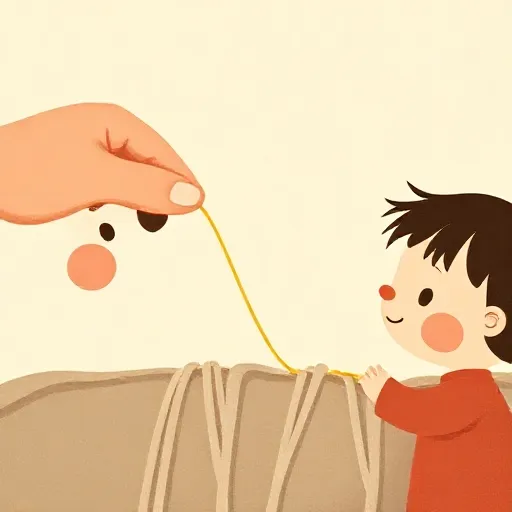
Long before it was a fancy term in a philosophy book, “analysis” was something you could do with your hands. In Homer’s Odyssey, Penelope’s husband Odysseus has been missing for twenty years, and a crowd of suitors is pressuring her to remarry. She promises to decide once she finishes weaving a funeral shroud. By day she weaves; by night she secretly unravels the whole thing. The Greek word analusis means “loosening up” or “unraveling,” and that’s exactly what she does to keep her problem at bay.
Soon the word leapt from cloth to questions. If you could unravel a tangled thread to see what it was made of, maybe you could unravel a confusing idea. This metaphor, the “loosening” of a knotted thought, is the oldest thread in the story of philosophical analysis. And the story has many twists.
Breaking Ideas into Pieces
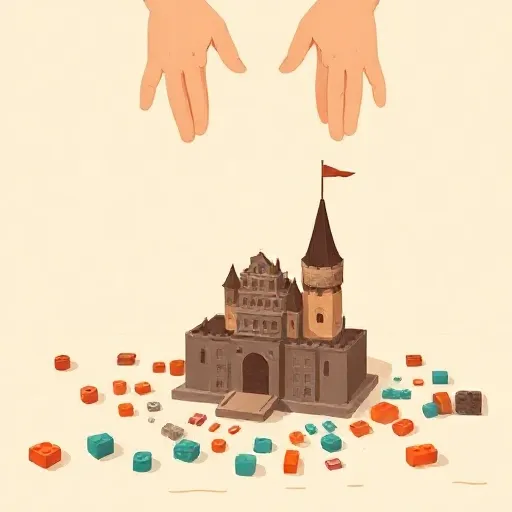
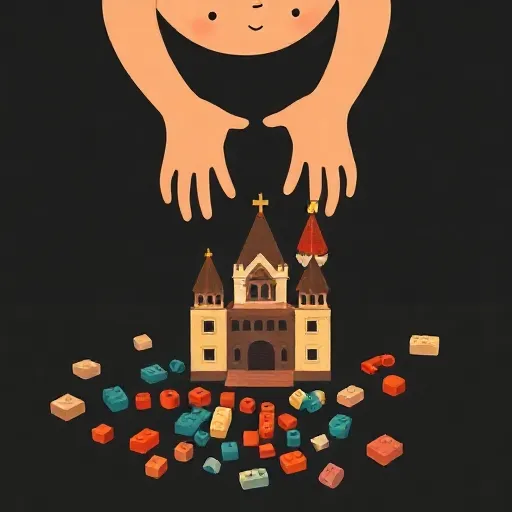
Ask someone today what “analysis” means and they’ll probably say: breaking something down into its parts. This is the decompositional conception. It’s the thinking behind a chemist pulling a substance apart into its elements, or a kid dumping out a Lego model to see exactly which bricks went where. In philosophy, the pieces you’re looking for are concepts—the smallest building blocks of a thought.
Socrates (c. 470–399 BCE) never used the word “analysis,” but he spent his days trying to define things like courage or justice by asking what all examples had in common. To him, a good definition was like the recipe for a concept. Plato (c. 428–348 BCE) turned this into a method of “division”: you would take a big group—say, all living things—and divide it again and again until you landed on a definition, like “human being = rational animal.” That is conceptual analysis in its earliest form.
Much later, René Descartes (1596–1650) turned decomposition into a rule for all science: “to divide each of the difficulties I examined into as many parts as possible and as may be required in order to resolve them better.” To solve a tricky question, break it into smaller and smaller ones until each piece is so simple you can’t doubt it. For Descartes, every complex idea could be taken apart like a clock.
Immanuel Kant (1724–1804) agreed, but only up to a point. He thought concepts in our heads could be clarified by unpacking their parts—what he called “analytic” judgments. But when it came to understanding the real world, he believed you needed much more than just pulling ideas apart. Still, the decompositional dream was powerful: if you could just find the right smallest pieces, everything might be explained.
Tracing a Problem Back to Its Source

But if you’ve ever untangled a knotted necklace, you know that sometimes you have to work backwards, loosening a thread here to see what’s really holding things together. This is the regressive conception of analysis, and it was the dominant picture in ancient Greece. The model was geometry.
Ancient geometers like Euclid (c. 300 BCE) proved their theorems by reasoning forward from simple, self-evident starting points—axioms or “first principles.” But how did they find those proofs in the first place? They worked in reverse. Suppose you want to prove a theorem. You pretend the theorem is already true and ask: “What would have to be true for this to be true?” Then you ask the same question about that earlier claim, and keep walking backwards until you reach something already known—a principle that nobody disputes. Then you can reverse direction and construct a proof. The forward journey was called synthesis; the backward search was analysis.
Aristotle (384–322 BCE) absorbed this idea and gave it a wider job: analysis, for him, meant tracing things back to their causes, to the most basic explanations. If you see a puddle, you can work backwards and realize that it rained last night. The puddle is what you started with; the rain is the deeper reason. Philosophy, in this tradition, is a kind of reverse engineering of the world.
This regressive picture stayed alive for centuries. Even when Descartes told everyone to break ideas into parts, his own geometry secretly relied on a back-and-forth between algebra and geometry—taking a shape, translating it into an equation, solving it, and translating back. That two-way movement, from what’s unknown to what’s already understood, is still the heartbeat of analysis in mathematics.
When You Have to Translate Before You Can Take Apart
The biggest twist in the story came at the end of the 1800s, when a quiet German mathematician named Gottlob Frege (1848–1925) created a whole new language for logic. Before Frege, people tried to analyze statements by looking at their ordinary grammar. But grammar, Frege saw, can be a terrible guide. It can fool you into thinking there are mysterious objects where none exist.
Consider the sentence “Unicorns do not exist.” If you take it apart in the obvious way, it looks like you’re talking about unicorns and saying they have the property of “non-existence.” But that’s bizarre—if unicorns don’t exist, what exactly is the subject of the sentence? Frege’s answer was to stop treating existence as a property of things. Instead, “unicorns do not exist” means: the concept unicorn has no instances. In logical notation, it becomes something like “there is no x such that x is a unicorn.” Suddenly the ghostly object disappears, and the puzzle dissolves.
Frege’s method was logical analysis—translating a statement into a precise logical form before trying to break it down or trace its foundations. His student (in ideas, if not in the classroom) Bertrand Russell (1872–1970) used this trick to “analyze away” all sorts of troublesome phrases. When we say “The present king of France is bald,” ordinary grammar suggests we’re referring to a real king. Russell showed you could rewrite it as three claims—there is a king, there’s only one, and he’s bald—all without ever assuming such a king exists. The tangled sentence gets clarified by being put into a new, logical shape.
The philosopher Gilbert Ryle (1900–1976) later showed how many everyday expressions are “systematically misleading.” Saying “Unpunctuality is reprehensible” sounds as if unpunctuality is a thing you could point to. But what we really mean is: “Whoever is unpunctual deserves reproof.” The job of analysis, Ryle thought, is to rewrite sentences so we stop imagining phantom entities and pay attention to what we’re actually claiming.
So sometimes you can’t just pull an idea apart directly. First you have to interpret it, translate it into a language that reveals its true structure. This interpretive dimension is at the core of the analytic tradition Frege and Russell started.
Does Analysis Change the Thing You’re Studying?

If you pull apart a knot, you understand the knot—but you also don’t have a knot anymore. That’s the deep unease at the heart of analysis. The problem goes back to Plato’s dialogue Meno: if you don’t already know what something is, how can you look for it? And if you do know, why do you need to analyze it? This is the paradox of analysis. If your analysis tells you something genuinely new, how can you be sure it’s still talking about the same thing? If it only tells you what you already knew, it seems useless.
In response, some thinkers argued that analysis doesn’t just reduce a thing to pieces—it also reveals its connections to everything around it. This is the connective conception. To understand what a hand is, maybe you don’t just break it down into fingers and skin and bones. You need to see how it fits with the rest of the body, how it grasps tools, how it greets another hand. A part is what it is only within a larger whole.
In the twentieth century, ordinary language philosophers like Ryle and J. L. Austin (1911–1960) insisted that analysis should map the relationships between concepts, not search for ultimate atoms. They spoke of clarifying “the logical geography of our knowledge” rather than reducing everything to a simple list of basic pieces. So analysis, in their hands, became more like drawing a map than smashing a rock.
This connective turn doesn’t replace the other kinds of analysis; it ties them together. When you trace an idea back to its foundations and when you break it into parts and when you translate it into a clearer form, you’re also showing how it weaves into a whole web of thought. Analysis, in the end, is rarely a single move. It’s a back-and-forth—unraveling and reweaving, pulling apart and rebuilding.
Why We Still Unravel Ideas Today

You don’t need to be a professor with a blackboard covered in logical symbols to do analysis. Any time you stop and ask, “Wait, what exactly do I mean by that?” you’re following the thread that started with Penelope’s unraveling. When you argue with a friend about whether something was “fair,” and you try to break down what fairness requires, you’re doing a tiny piece of conceptual analysis. When you’re solving a math puzzle and work backwards from the answer to see what rule would produce it, you’re thinking in the regressive style. When you realize a sentence like “I have no time” doesn’t mean you literally possess some substance called “time,” you’re noticing how language can mislead you, just as Ryle warned.
Philosophical analysis matters because the ideas we live by—justice, knowledge, love, freedom—are tangled things. We inherit them through half-remembered lessons, catchy slogans, and the messy way we talk. Unraveling them isn’t about destroying them; it’s about seeing clearly what’s really there. It’s about learning when a knot can be loosened and when it needs to stay tied.
Think about it
- Think of a concept that really matters to you—like “cool,” “brave,” or “generous.” Can you define it in exactly the right way, so nothing is left out and nothing extra is included? Would your friends agree with your definition?
- If someone claimed that “wishing on a star works,” how could analyzing the sentence “wishing on a star works” help you figure out what you should believe? What would you need to translate or untangle first?
- Are there some things—like a joke, a friendship, or a beautiful sunset—that lose something important when you pull them apart? Or can you analyze everything without ever harming it?