Are There Only Ten Ways to Exist? A Medieval Mind Says Yes
A shock in the lecture hall
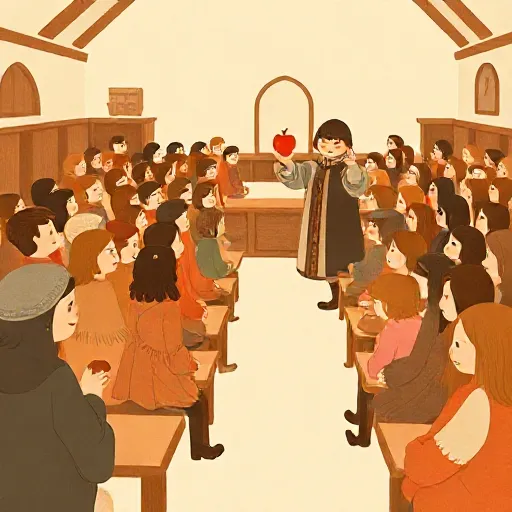
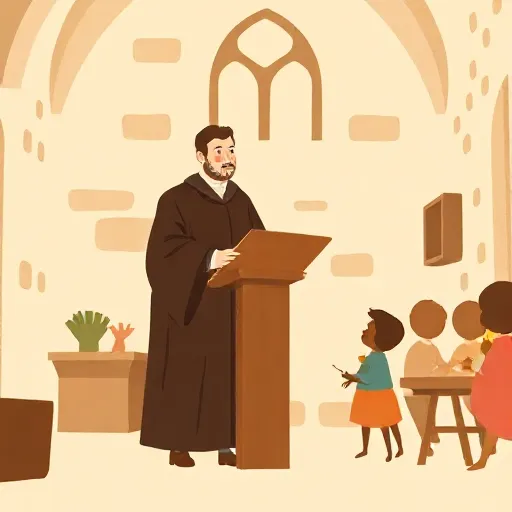
On a cold morning in 1393, a scholar named Robert Alyngton (died c. 1398) stood up in a packed hall at Oxford and asked his students a question that still feels alive: when you point at a brown dog and call it a thing, what exactly are you pointing at? The dog itself? Its brownness? The fact that it’s taller than the cat? Alyngton had an answer that was bold even for his own time. He thought the entire universe splits into exactly ten categories — ten most‑basic ways something can exist — and that each category is as real as the stones of the college itself.
Alyngton was a master of arts, a doctor of theology, and twice chancellor of the university. He had been a fellow of Queens College, the same Oxford college where John Wyclif (c. 1328–1384) once studied. Alyngton was known as a sharp logician, and he wrote a long commentary on Aristotle’s Categories, the book that first listed those ten ways of being. But unlike many readers of Aristotle, Alyngton didn’t think the categories were just handy boxes for sorting words. He was a *realist: he believed the world itself — trees, horses, colours, shapes, relations — actually came arranged in ten real departments, and that our language simply follows that arrangement.
What is substance? The stool the whole world sits on

If reality is a filing cabinet full of things, then substance is the drawer that holds all the rest. Alyngton called it the category of being‑by‑itself. A substance doesn’t need to be in something else in order to exist; it stands on its own. Socrates is a substance. A particular horse is a substance. Their brownness, their size, and their location are not substances — they are accidents that live in substances.
Alyngton looked at several earlier definitions and chose one that came from Wyclif. What makes something a substance is not simply that it can have a colour or a shape stuck to it. Rather, a substance is what can underlie potency and act — the most basic inner split between what a thing could be and what it actually is right now. A lump of clay is a substance because it has the real capacity to become a bowl, and that capacity is actually part of what the clay is. A colour, by contrast, doesn’t have that kind of inner engine. It just makes the clay look a certain way.
Alyngton claimed that only primary substances — individual things like this dog, this apple, this boy — are substances in the strictest sense. Everything else in the world, including the universal nature “dog‑ness,” depends on primary substances to exist. If every primary substance vanished, nothing would be left. That makes the apple on the table the true cornerstone of reality, and everything else hangs on it.
The things that live in substances: accidents

Substances don’t just sit there like naked lumps. They are extended, they have qualities, and they stand in relations to other things. Alyngton insisted that these accidents are not just words — they are real forms that exist in the substance, even though they can’t survive on their own.
He gave special attention to three kinds of accident. Quantity is what makes a material substance actually have parts outside parts — left hand separate from right foot. Quality is what makes something the way it is: being brown, being warm, being able to run. Relation is a curious form that connects two substances together at once, like the link between a father and a son. For Alyngton, relation is the weakest accident because it needs three things to exist at the same time: the subject, the object, and some absolute feature (like a size or a colour) that grounds the relation.
Many of Alyngton’s rivals had tried to shrink accidents down to just ways of talking. William of Ockham (c. 1287–1347) thought it was a waste to say that quantity is a thing separate from substance. If a lump of clay gets stretched, you can describe the new shape without positing a hidden “quantity‑form” inside it. Alyngton disagreed completely. He argued that you cannot have actual extension without the real presence of the general form of quantity. For him, calling a dog “heavy” isn’t just a figure of speech — it names a real property that is really distinct (in one way) from the dog itself, even though it can’t float away and exist on its own.
The real pattern behind our words: universals
If I say “Socrates is a man,” what makes that sentence true? Alyngton’s answer reaches into one of the hottest debates of the Middle Ages. The word “man” picks out a universal — a common nature, humanity, that really exists outside any human mind. And that universal is not a vague cloud floating above all people. It is really (realiter) identical with each individual human, but formally (formaliter) distinct.
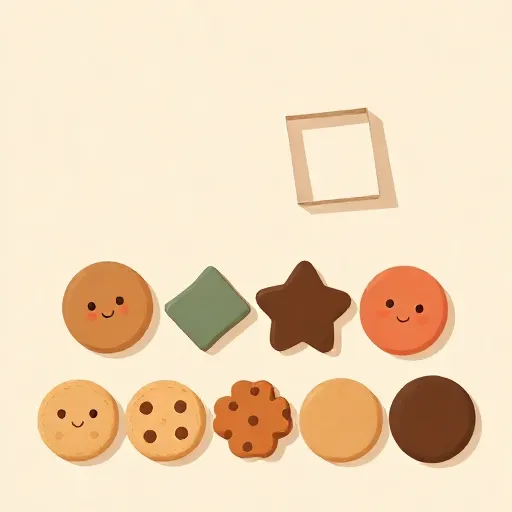
Think of a cookie cutter and a batch of dough. The shape is truly in every cookie, and without that shape the cookie wouldn’t be the cookie it is. But if you look at the shape just as a pattern — as something that could show up in many different cookies — you are considering it in a different way. Alyngton put it this way: a universal like humanity is, in reality, the very same thing as Socrates. Yet considered as a universal, it is something that can be shared by many, and in that formal sense it is not identical with Socrates considered simply as an individual. That subtle balance allowed him to say both that universals are fully real and that individuals are not split into two separate chunks — you don’t pick Socrates and his humanity out of two different pockets.
This commitment pushed Alyngton to redraw what predication means. A normal sentence like “Socrates is white” corresponds to a formal predication: the form whiteness is directly present in Socrates. But a more puzzling sentence, like “Humanity is animality,” doesn’t mean that the form animality is directly stuck inside the form humanity. Instead, it expresses a remote inherence — a predication by essence. Humanity and animality share part of their metaphysical makeup, but one isn’t a part of the other in the same way that whiteness is a part of a white thing. Alyngton used this double‑layered logic to keep his realistic picture of language without falling into contradictions that earlier realists had struggled with.
Mapping the world without leaving your mind
Alyngton pushed his realism one step further than almost anyone before him — even further than Walter Burley (c. 1275–1344/45), who was his main source. He argued that second intentions — concepts like “individual,” “species,” or “category” — aren’t just handy mental labels. They correspond to real features that actually inhere in things.
That sounds wild, but it solved a problem that kept other realists up at night. If every general term must point to a common nature, then the word “individual” should point to a common nature too. But that would mean there is a bizarre ingredient — an “individual‑nature” — shared by all individuals, which seems absurd because being an individual means not being shared. Alyngton’s fix was clever: he grouped terms like “individual” and “first substance” with atomic expressions such as proper names. The word “individual” doesn’t name a common thing; it works like a range‑narrowed expression that points to a singular thing but picks it out precisely as non‑universal. So being an individual turns out not to be a positive extra quality, but a kind of built‑in boundary — a thing’s not‑being‑common.
The whole strategy shows what Alyngton wanted more than anything else: to replace talk about minds with talk about the world. He thought logic is the study of real structural forms that exist independently of us. When you think clearly, you aren’t imposing order on a messy world; you are tracing the real skeleton that was there all along.
Why it still matters: sorting your own world

Maybe you never sat in a cold Oxford hall in 1393. But today you still open your closet and separate hoodies from jeans. You point at a pet and say, “That’s a dog.” You ask why your skateboard is faster than your friend’s. In each little act, you are relying on a hidden map of categories — and Alyngton wanted to know whether those categories are already carved into the world itself.
Without knowing it, you’re taking sides in his debate. If you think there really is a fixed common nature “skateboard‑ness” that makes a skateboard a skateboard, you’re sounding a bit like a medieval realist. If you think the word “skateboard” is just a noise we learned to produce when we see certain collections of wheels and wood, you’re closer to Ockham. Alyngton’s huge ambition — to anchor every word in something unshakeably real — didn’t win the day, but it still forces a question worth asking: do we discover the world’s joints, or do we make them up as we go?
His world was made of ten categories, each with its own strict way of being. Ours seems messier. But every time you’re certain that a thing is a thing, you’re holding onto a little piece of Alyngton’s vision: the idea that reality, deep down, fits into a pattern.
Think about it
- If you could see all ten of Alyngton’s categories as coloured layers in the world around you right now, which layer would be brightest — substance, quality, quantity, or relation — and why would that layer stand out most?
- Imagine you find a strange object on the street that nobody has ever seen before. Would you believe that there is already a real “nature” of this new thing, waiting to be discovered, or does its nature only come into existence once we name it?
- Think of a sentence you said today, like “My brother is taller than me.” If Alyngton is right, that sentence points to a real relation. If his opponents are right, it’s just a convenient way of talking. Which answer makes the world feel more solid to you — and which makes language feel more powerful?