
Why Did Algebra Stop Being All About Numbers?
The Mystery of Xavier’s Age
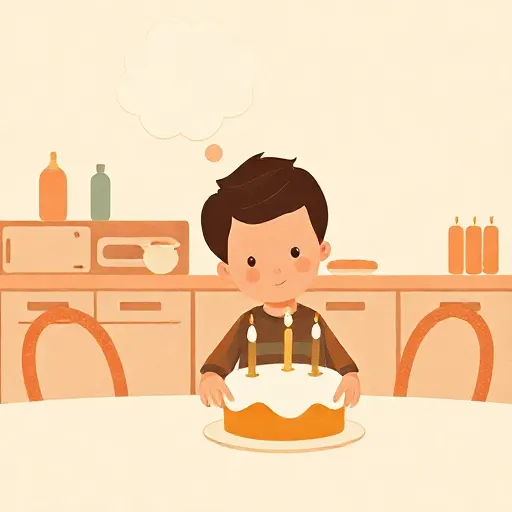
Xavier’s uncle asks, “If you’ll be three times your current age in four years, how old are you?” Xavier stares at the cake, then scribbles on a napkin. Instead of guessing, he writes a tiny code: 3x = x + 4, where the letter x stands for his present age. He subtracts x from both sides, and suddenly 2x = 4, so x must be 2. Xavier is two.
Right after, a harder riddle pops up: Yvonne is half Xavier’s age, but her age squared is twice his. This time two unknowns need two pieces of the puzzle. He writes x = 2y and x = y²/2, lines them up, and discovers two possible answers: the pair could be newborns (0 and 0) or an eight‑year‑old with a four‑year‑old sidekick.
That is elementary algebra — treating numbers like placeholders you can rearrange with a handful of trusted operations. But the real story of algebra doesn’t stop with finding x. It starts.
When Algebra Met Geometry
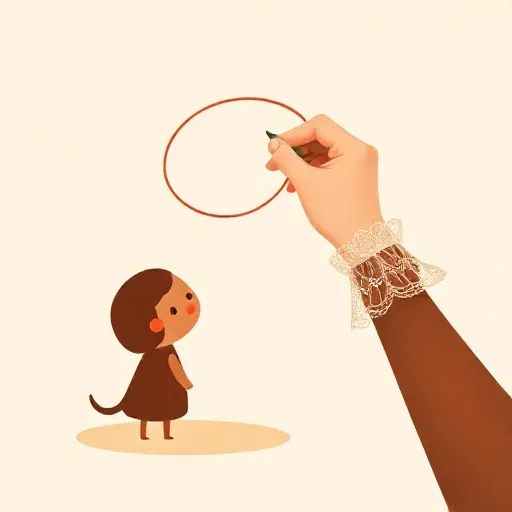
A French philosopher and mathematician named René Descartes (1596–1650) had an idea that sounds like magic: every shape is just an equation in disguise. He imagined a flat plane with a starting point O (the origin) and two number lines crossing it — the x‑axis running east‑west, the y‑axis north‑south. Any spot on the plane gets a pair of numbers, its Cartesian coordinates, telling you how far right and how far up it sits.
Then he wrote the equation of a straight line, y = 3x + 5. Every point that makes that equation true — (0,5), (1,8), (2,11) — falls exactly on the same line. A circle is just as sneaky. Using Pythagoras’s rule that the distance from (x,y) to the origin is the square root of x² + y², a circle of radius r becomes x² + y² = r². All those points, when plotted, trace the perfect round edge.
Suddenly algebra could draw and dissect shapes that would be a headache with a ruler. But Descartes’ trick did something deeper: it exposed that the same rules could describe completely different beasts — numbers, points, curves — as long as they followed the same basic laws.
The Rules That Rule the Numbers
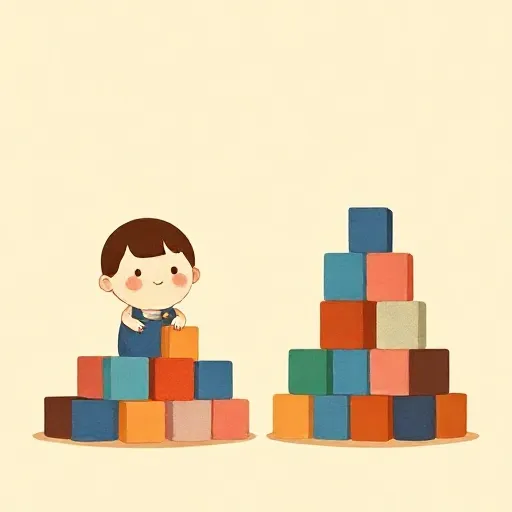
Open any algebra book and you’ll meet small, powerful facts like x + y = y + x and x + (y + z) = (x + y) + z. They seem boring until you realize they’re not really about specific numbers — they’re about any numbers. The first, called commutativity, says you can swap the order of addition and get the same result. The second, associativity, says it doesn’t matter where you put the parentheses when adding a chain.
For centuries mathematicians thought these laws were just obvious properties of numbers. But what if numbers are just one kind of toy in a bigger playground? Around the nineteenth and early twentieth centuries, algebraists began flipping the question. Instead of starting with a pile of familiar numbers, they started with the rules themselves and asked: what kinds of things obey only these rules?
That gave birth to abstract algebra. Imagine a set of anything — moves, rotations, even words — together with a way of combining two things to get a third. If that combination follows certain laws, the whole set becomes an algebraic structure. The real magic: once you prove a theorem about the laws alone, the theorem automatically works for every single system that follows those laws, whether it’s made of numbers, shapes, or something nobody has imagined yet.
The Algebra of Twists and Flips
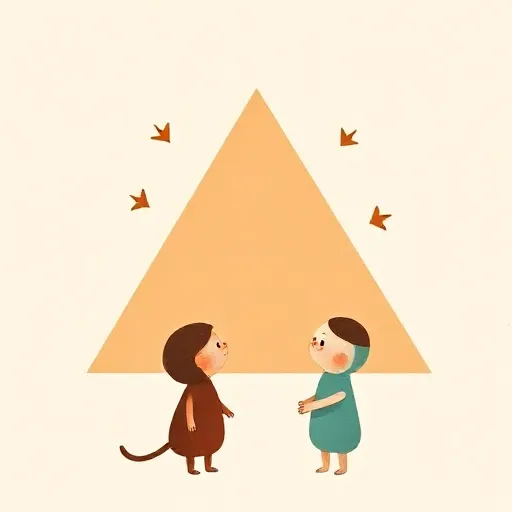
A structure that follows associativity and always has an “undo” action is called a group. The undo rule means every move has an inverse that gets you back to where you started. Also, there’s an identity move — doing nothing — that leaves everything unchanged.
Take an equilateral triangle. You can rotate it by 120°, 240°, or 0° (the identity). You can also flip it over any of its three mirror lines. Combine any two of these six moves and you’ll land on another of the six. But here’s a surprise: the order matters. Flip, then rotate? You end up with a different final position than rotate, then flip. That means the group is non‑commutative: a ∘ b isn’t necessarily b ∘ a.
The same thing happens with the six ways to rearrange three labeled balls, or with the countless symmetries of a cube. Groups turn the study of shape into a kind of pure pattern arithmetic. Add more rules — like requiring a second operation that distributes over the first — and you get a ring. If that second operation is commutative and every nonzero element has a reciprocal, you’ve got a field: a number system where you can add, subtract, multiply, and divide (except by zero). The rationals, the reals, the complex numbers — all fields. And even finite fields exist, like arithmetic on a clock with a prime number of hours, where every nonzero hour hand has an exact dividing partner.
These abstractions let mathematicians prove things about whole families of systems at once. They also became a bridge from the chalkboard to the real world.
Why It Still Shapes Your World

When your phone scans a crumpled QR code on a bus stop poster, it isn’t just reading black and white squares. The code uses a finite field — a tiny set of symbols with their own addition and multiplication tables — to catch errors and rebuild missing pieces. The same algebra of finite fields keeps satellite signals crisp and passwords scrambled.
Video games and animated movies lean on the algebra of vector spaces and matrices to spin 3D dragons and reflective lakes in real time. And the deepest puzzles of number theory, like Fermat’s Last Theorem (proved in the 1990s after 350 years of stumped mathematicians), were cracked by treating whole families of geometric shapes as algebraic objects.
Back at that birthday table, Xavier only needed to solve for x. But every time you stream a show, watch a map pinpoint your location, or send a secure message, you’re leaning on the insight that rules matter more than the things they rule. Algebra grew up by asking not “What is the answer?” but “What stays true no matter what world we’re in?” That question keeps building bridges between numbers, shapes, and everything in between.
Think about it
- If you invented a new operation called “splat” where 2 splat 3 = 3 splat 2 only works sometimes, what real‑world actions would obey it?
- Why do mathematicians care more about proving a rule for every possible number system than about checking it for big numbers on a computer?
- Could you imagine a universe where adding 2 and 2 always gave 5? What would a shape like a circle look like in that universe?