

Does Fairness Mean Ignoring Race, or Paying Attention to It?
Allan Bakke’s Rejection Letter

In 1973, a man named Allan Bakke applied to the medical school at the University of California, Davis. His grades and test scores were higher than most of the students who got in. But the school had set aside sixteen out of one hundred seats for minority applicants — people from racial groups that had been underrepresented in medicine. Bakke was white. He was rejected. He felt this was unfair, so he sued.
That lawsuit became one of the most famous cases about affirmative action — policies that give some kind of advantage to members of groups that have faced discrimination. Affirmative action can mean actively seeking qualified applicants of all races, but it often means using race or gender as a “plus factor” in decisions.
The fight over affirmative action exploded in the early 1970s when the U.S. government told universities and other contractors that they had to set goals and timetables to hire more minorities and women. Some professors shouted that this was reverse discrimination; others cheered. At the same moment, philosophers were turning their attention to real-world justice. John Rawls (1921–2002) had just published his huge defense of a fair society, and new philosophy journals wanted to tackle war, civil rights, and women’s liberation. Philosophers like Judith Jarvis Thomson (1929–2020) and Thomas Nagel (born 1937) jumped into the affirmative action debate, asking: Is it ever just to give someone a preference based on race?
The question at the heart of Allan Bakke’s story isn’t just legal — it’s moral. If society discriminated against black people for centuries, is it fair now to give black applicants a boost? Or does that just replace one kind of unfairness with another?
Is It Fair to Make Up for Past Wrongs?

Judith Jarvis Thomson gave one of the first philosophical defenses of racial preferences. She argued that preferential hiring for women and minorities could be a form of redress — a way to make up for years of being shut out of good jobs. If a company had a history of not hiring black people, then giving a leg up now could help correct that wrong.
Many philosophers pushed back. They said redress is a strange idea when the people getting the preference are often well-educated and least likely to have been directly harmed, while the people who lose out — younger white men — are least likely to have been the ones doing the discriminating. Critics argued that such a policy punishes innocent white applicants and rewards minority applicants who may not have personally suffered from past exclusion.
Other defenders like Mary Anne Warren (1946–2010) and James Rachels (1941–2003) looked at the problem differently. Warren suggested that in a world full of sexism, the average white man has likely benefited in many invisible ways from discrimination against women. Giving a woman a job preference might simply offset those hidden advantages. Rachels argued something similar: a white applicant’s stronger credentials often don’t reflect greater effort or talent — they reflect the luck of being born white and not having to face racial obstacles. Giving preferences to black applicants could neutralize that unearned advantage.
But even Rachels worried that blanket preferences were too blunt. Not every white person had the same advantages, and not every black person faced the same obstacles. If the goal is to distribute opportunity fairly in tiny, individual portions, a one-size-fits-all preference might itself be unfair.
Then there was a deeper challenge: even if preferences compensate for unfairness, do they violate a more basic principle? Alan Goldman (born 1942) tried to state that principle clearly. He argued that in a just society, rational people would agree to a rule: jobs and places should go to the most competent person. That rule respects equal opportunity. But, Goldman added, if the whole system is already rigged with unequal opportunities, short-term violations of the rule (like racial preferences) could be justified if they help create a future where the rule can actually work fairly for everyone. So his principle wasn’t absolute — it had wiggle room.
Other critics wanted an iron rule. They said using race to help some people is just as bad as using race to harm others. Lisa Newton (born 1933) called it reverse discrimination — the same kind of injustice as old Jim Crow laws, just aimed in a different direction. Any classification by race, they insisted, violates the idea that all citizens are equal.
What Does the Constitution Say?
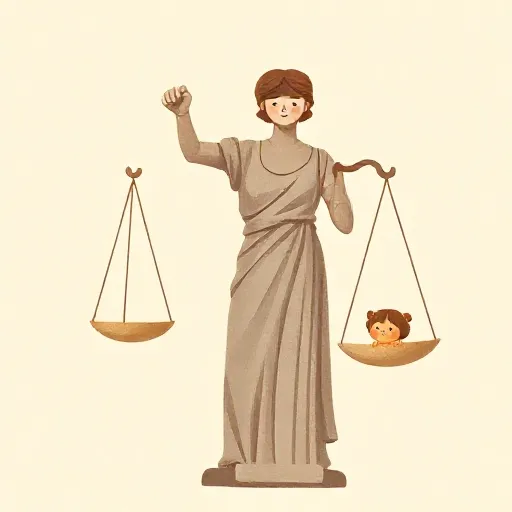
Allan Bakke’s case went all the way to the Supreme Court. The medical school defended its special admissions program with several reasons: fixing past discrimination, increasing doctors in underserved communities, and getting the educational benefits of a diverse student body. The justices were deeply split.
Justice Lewis Powell wrote the deciding opinion. He said that any use of race by the government is immediately suspect. To survive, it must be precisely tailored to serve a compelling governmental interest — a really important public goal. He knocked down the school’s first three reasons. Fixing general societal discrimination? The school hadn’t proven any specific legal violations. More doctors for underserved areas? No evidence the policy would lead to that. But the fourth reason — the educational benefits of diversity — he found legitimate. A university could claim that students learn better when surrounded by classmates from different backgrounds.
However, Powell said the school went too far by reserving a fixed number of seats only for minorities. That was a quota, which violated the idea of individual consideration. Instead, he suggested, race could be a “plus” factor, one among many, like having an unusual talent or coming from a farm. As an example, he pointed to Harvard’s admissions system, which treated race as a flexible tip.
Justice William Brennan and three others strongly disagreed. Brennan argued that the Constitution’s promise of equal protection is an anti-caste principle: it bans any law that stamps a group as inferior. Jim Crow laws stigmatized black people as lesser; the medical school’s policy was meant to undo that stigma, not create a new one. A white applicant like Bakke might feel upset, but he wasn’t treated as a second-class citizen. The same rule, applied to very different circumstances, need not yield the same result.
The philosopher Ronald Dworkin (1931–2013) later expanded on this idea. He said we have a right to be treated as an equal — with the same concern and respect as anyone else — but not always a right to equal treatment (getting the very same thing). The government can sometimes burden you for a larger public good, as long as it doesn’t do so out of contempt or prejudice against your group. Racial classifications, Dworkin argued, aren’t automatically wrong; it’s the purpose and effect that matter.
Why Do Colleges Say Diversity Matters?

After the Bakke ruling, many universities adopted admissions policies that treated race as a plus. But by the early 2000s, new lawsuits challenged the University of Michigan’s programs. In the 2003 case Grutter v. Bollinger, the Supreme Court upheld the law school’s approach. Justice Sandra Day O’Connor (1930–2023) wrote that student body diversity is a compelling state interest and praised the school’s holistic review of each applicant — supposedly no mechanical formulas, just a careful look at all the ways a student could contribute.
But critics noticed something odd. The law school’s admissions director secretly tracked the racial makeup of the incoming class to make sure there was a “critical mass” of black and Hispanic students — about six to seven percent. Meanwhile, the undergraduate admissions office used a point system that automatically gave twenty extra points to underrepresented minorities, which the Court struck down as too mechanical. Yet both produced similar numbers. Justice Antonin Scalia called the law school’s process a sham.
Beyond the legal maneuvering, many philosophers and social scientists questioned the diversity argument itself. Universities and big companies filed friend-of-the-court briefs claiming that cross-racial interactions improved cognitive skills, problem-solving, and preparation for a global workforce. But these claims had problems. First, they often confused racial diversity with general diversity — exposure to different cultures, ideas, and life experiences, which could come from many sources. Second, if racial diversity is essential, then the many black students who attend historically black colleges (where most classmates share their race) must be getting a worse education — a conclusion few would endorse. And universities worked hard to keep black and Hispanic enrollment at a steady percentage while paying less attention to other kinds of difference, suggesting that race wasn’t just one factor among many.
Justice O’Connor added a different, potentially stronger argument: the legitimacy of American institutions. She pointed to a brief from retired military generals who explained that a racially integrated officer corps is essential for the armed forces to seem legitimate — both to the enlisted soldiers and to the public. The same, she said, applied to elite law schools. If the path to being a senator, judge, or general is visibly closed to certain races, citizens will lose trust in those institutions. The philosopher Elizabeth Anderson (born 1959) has argued similarly: in a democracy, elites must be integrated so that they can understand and represent the concerns from all walks of life. This isn’t about what students learn in their heads — it’s about who gets to lead and whether everyone can see themselves in that leadership.
The Supreme Court Changes Course: Harvard 2023

In 2023, the case Students for Fair Admissions v. Harvard reached the Supreme Court. The group argued that Harvard’s admissions policy discriminated against Asian American applicants and violated the Civil Rights Act. Chief Justice John Roberts wrote for the majority and struck down Harvard’s program — but without overruling Grutter entirely.
Roberts used the very framework O’Connor had set up. He said Harvard’s goals, like training future leaders and producing new knowledge, were too vague to measure. The racial categories the university used (grouping together students of vastly different backgrounds) were too blunt. The policy risked stereotyping. And, crucially, Harvard had no endpoint; O’Connor had suggested that twenty-five years after 2003, racial preferences might no longer be necessary.
The Court did not say that race could never be considered. But it demanded that any use of race be precisely tied to a measurable goal and have a stopping point. Roberts also left a footnote explicitly not deciding about military academies, which some took as a signal that the legitimacy argument might still survive.
In the aftermath, attention shifted to legacy admissions — preferences for children of alumni — which many now called an even more obvious injustice. Standardized tests like the SAT came under renewed fire. And public opinion remained divided.
What Counts as Fair?

You might be years away from applying to college, but the central questions of affirmative action are already at play in your life. What does it mean to treat people fairly? Should we ignore differences like race and gender entirely, or should we pay attention to them in order to undo unfairness from the past? If a school puts extra resources into helping students who started with fewer advantages, is that favoritism or justice?
Philosophers don’t agree. Some think that true fairness demands we never let race influence decisions; others think that acting as if race doesn’t exist just locks in existing inequalities. The debate hasn’t been settled, and you might someday help shape the answer.
Think about it
- If a school gives extra support to students from families that couldn’t afford tutors, is that the same kind of preference as considering race? Why or why not?
- Imagine you’re on an admissions committee, and the last spot comes down to two equally strong applicants — one white, one black, and the university’s student body is overwhelmingly white. What would you decide, and what would be your reason?
- Is it possible to create a society where race truly doesn’t matter without ever paying attention to race along the way? Can you think of an example from another area of life where you have to focus on a problem to make it disappear?