
Why Does a Statue Grab You and Hold You Still?
The Hidden Geometry of Beauty
You’re standing in front of a white marble statue. It isn’t a person you know. You can’t eat it, wear it, or use it. But something about its shape and smoothness makes you stop and stare. That something, philosophers say, is an aesthetic experience — a special kind of experience you have when you encounter a work of art or a striking view of nature. The big question is: what exactly is this experience focused on?
For a very long time, people thought the answer was form — the way an object’s parts fit together. Around the year 380, Augustine (354–430) wrote that music pleases us because its parts are in proper proportion. Over 800 years later, Thomas Aquinas (1225–1274) argued that beauty happens when matter is arranged into the right form, and glimpsing that arrangement gives us pleasure all by itself. During the Italian Renaissance, Leon Battista Alberti (1404–1472) called beauty a “reasoned harmony” of all the parts inside a body.
The most famous twist on this idea came from Immanuel Kant (1724–1804). He peeled form away from any purpose it might serve. When you judge something beautiful in a “pure” way, he said, you don’t think about what the object is for. A flower, a shell, an abstract painting — their beauty gives you pleasure just because their shape delights your mind, not because they are good for anything. In the early 1900s, the critic Clive Bell (1881–1964) pushed this further, claiming that all great visual art has “Significant Form” — a special arrangement of lines and colors that sparks a rare thrill quite different from ordinary feelings.
The problem? Many philosophers think it’s impossible to cleanly separate form from the content or meaning something carries. A sad melody’s shape and its sadness seem tangled together. And why would form alone be so valuable to us? Even critics of pure formalism agree that paying attention to form matters, but few think it’s the whole story.
The Pleasure Button in Your Brain

Maybe beauty is nothing mysterious — maybe it’s just a power to make you feel good. In the 1700s, many philosophers began thinking of beauty like a secondary quality, a feature that isn’t really “in” the object the way its size is, but is instead the object’s ability to produce a certain feeling in you. Just as sugar has the power to taste sweet, a painting has the power to give you a certain pleasure.
David Hume (1711–1776) said bluntly that beauty is “nothing but a form, which produces pleasure.” Edmund Burke (1729–1797) applied this idea to the sublime — things like a massive storm or a jagged mountain peak that would be terrifying if they were right on top of you, but from a safe distance they produce a thrilling delight. For these thinkers, an aesthetic experience just is an experience of an object’s power to please or excite you.
This view runs into trouble fast. If beauty is just whatever makes you feel good, then anything that pleases you should be beautiful — even a sugar rush. But we don’t treat aesthetic pleasure that way. When someone says a movie was brilliant, we don’t just accept their report as proof; we argue about whether the movie really deserves that praise. Hume himself later made a correction: he said beauty is only what pleases ideal judges — people who are unusually sensitive, well-practiced, and free from prejudice. That moves the idea closer to something deeper: that aesthetic pleasure isn’t just a private buzz, but a response the object somehow merits.
“You Ought to Like This!”
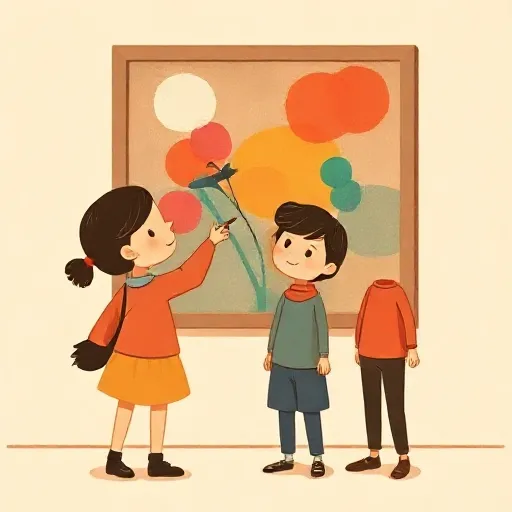
Kant offered a radical new direction. When you find something beautiful, he said, the pleasure you feel isn’t just self-enjoyment. Your mind unconsciously feels that the object deserves that very pleasure, and that everyone else ought to feel the same way. That’s why we argue about taste as though there’s a fact of the matter. You don’t just say, “This painting pleases me”; you say, “This painting is good,” and you expect others to agree if they’re paying proper attention.
Crucially, Kant insisted that this pleasure is disinterested — you don’t care about owning the object or using it. Your pleasure is indifferent to whether the thing actually exists in front of you. You enjoy the apple in a still-life painting, not because you could eat it, but simply because of the way it looks. This idea — that aesthetic experience involves enjoying something without wanting to consume or possess it — has echoed through centuries of thought.
The demand that others feel the same way introduces normativity into our experience. It’s not just a “must” inside your head; it feels like a requirement that comes from the artwork itself. Some later philosophers softened this claim. They think an artwork can make a personal demand on you — it asks for your admiration, not necessarily everyone’s — but the basic insight remains: aesthetic experience isn’t simply a private feeling; it carries a sense that a response is merited.
When a Painting Seems Sad
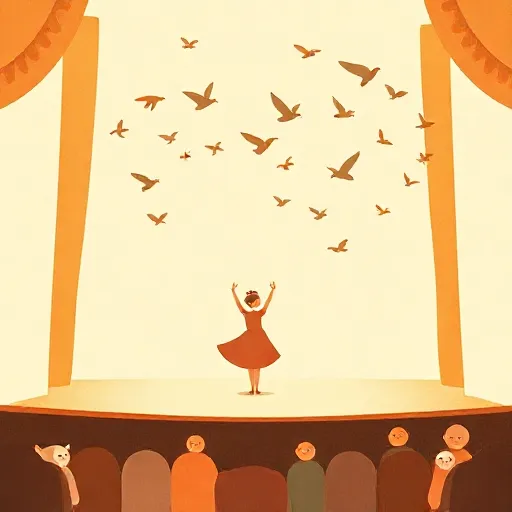
There is another powerful candidate for the focus of aesthetic experience: expressive properties. A piece of music can sound mournful. A sculpture can feel angry or lonely. So perhaps what we’re really tuned into is something the artwork expresses.
The simplest version of this thought is a transfer view: the artist felt an emotion, poured it into the work, and you catch that emotion when you experience it. The Russian novelist Leo Tolstoy (1828–1910) declared that real art “infects” the audience with the feelings the artist once lived through, creating a spiritual bond between them.
A more careful idea is the correspondence view, developed most fully by Susanne Langer (1895–1985). She argued that music doesn’t literally transmit a composer’s sadness. Instead, the shape of music — its rises and falls, its tension and release — has the same pattern as the shape of a feeling. When you hear a melody, you recognize that pattern, and the music becomes a symbol for life’s emotional rhythms. The experience, she said, is not just recognizing the similarity; it’s a gripping, unified moment of “getting” it.
Some philosophers take an even stronger position: expression transforms the emotion itself. R.G. Collingwood (1889–1943) thought that before an artist expresses a vague fear, the fear is murky and overwhelming. By giving it a precise form in paint, words, or notes, the artist clarifies it and gains control over it. The audience does the same thing: reading a poem, you aren’t just receiving the poet’s emotion; you are actively constructing your own clarified feeling using the poet’s words.
In every case, the central claim is that aesthetic experience is focused on how an object expresses something beyond what you literally see or hear — and that engaging with that expression is what makes the experience so powerful.
Why the Puzzle Still Matters

You’ve probably had arguments like this: a friend puts on a song and says, “You have to listen to this — it’s amazing.” You listen and feel nothing. Your friend insists you’re missing something. You push back: “No, it’s just boring.” Both sides act as though there’s a correct answer. That’s the ghost of Kant in everyday life.
Philosophers have given us multiple lenses for understanding what’s happening in those moments. Maybe the song’s value lies in its elegant structure (the formalist lens). Maybe it simply creates pleasure in your friend’s brain but not in yours (the power-to-please lens). Maybe your friend feels that the song merits a certain shiver of admiration, and her frustration comes from the thought that you ought to feel it too (the merit lens). Or perhaps she’s responding to an emotion the melody seems to express, an emotion you don’t yet hear (the expression lens).
None of these answers is obviously the final one. But together they reveal why aesthetic experience is so strange and so valuable. When you stare at stars that can’t feed you or protect you, when you replay a piece of music even though it changes nothing practical in your day, you are doing something deeply human. You are valuing an appearance, a feeling, a pattern for its own sake — and you are doing it in a way that reaches toward other people, demanding that they see what you see. That’s why, 250 years after Kant, we still argue about playlists, museums, and sunsets. The experience of beauty is never just about the thing you’re looking at. It’s also about the way you think other minds ought to respond to it.
Think about it
- If you love a song because it cheers you up, is that the same as finding it beautiful, or is it more like finding a joke funny? How might you tell the difference?
- Imagine a friend who hates a movie you think is extraordinary. Does it make sense to say they are wrong? If so, what could possibly make them wrong — besides the fact that most people disagree?
- Think of something you find deeply beautiful that has absolutely no practical use. Why do you think human beings spend time and money on such things, sometimes for their whole lives?