
Is a Word Just a Sound? Peter Abelard’s Fight Against Invisible Things
A Student Who Wouldn’t Stay Silent

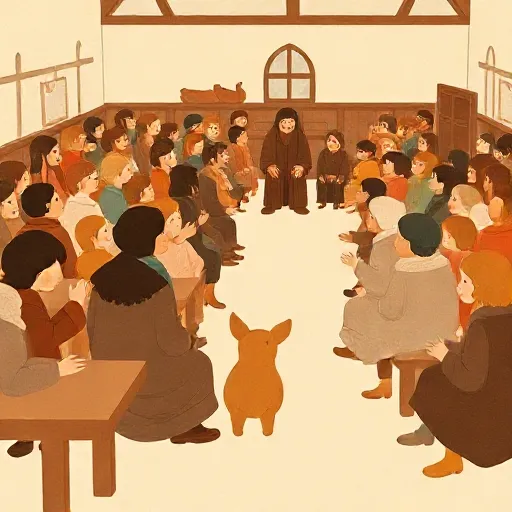
Peter Abelard (1079–1142) was born in a small town in Brittany, but he didn’t want to be a knight. He wanted ideas. He gave away his inheritance and spent his early years wandering from school to school, searching for the best teachers. In Paris around 1108 he found William of Champeaux, the most famous philosopher of the day. Abelard sat in the back of the lecture hall and listened — then refused to agree.
The fight was about universals. A universal is a word like “human,” “animal,” or “whiteness” — something that seems to apply to many different things at once. William believed that universals were real, invisible ingredients shared by all the things that have the same name. Abelard thought William was seeing ghosts in language. He stood up and, in front of the whole class, argued that universals are nothing but words. By his own account, he won the debate. Soon students flocked to hear the young man who dared to say the emperor had no clothes.
Abelard set up his own rival schools. He wrote, he taught, he argued. Then his life took an even more dramatic turn: he fell in love with Héloïse, a brilliant young woman who was studying with him. The affair ended in disaster. Abelard was attacked and castrated; he became a monk, Héloïse a nun. For the rest of his life, he moved from monastery to monastery, still teaching, still writing, and still making enemies. But through all the turmoil, he never stopped treating philosophy as a kind of battle — and his sharpest weapon was logic.
The Battle Over Universals: Words vs. Invisible Things

Here is the problem. You point to Socrates and say, “He’s human.” You point to Aristotle and say, “He’s human, too.” Does that mean there is some single thing — a humanity — that both of them share, like a secret ingredient baked into each person? Many philosophers in Abelard’s day said yes. They thought universals were real items in the world, present whole and entire in every individual that falls under them. That view is called realism about universals.
Abelard disagreed. He argued that realism leads to nonsense. Imagine the universal animal is a single thing that exists entirely inside a man and entirely inside a donkey at the same time. A man is rational; a donkey is irrational. If the very same thing — animal — is right there in both, then that one thing would have to be rational and irrational at the same time and in the same respect. That’s a contradiction. And if you try to escape by saying the man and the donkey are really two different animals, Abelard has a devastating reply: then Socrates is an animal, the donkey is an animal, and because each is wholly the same animal, Socrates would actually be the donkey. That’s absurd.
For Abelard, the only way out is to admit that universals are not things at all. They are words — names — that we use to talk about many individuals at once. This view is called nominalism (from the Latin nomen, meaning “name”). When you say “human,” you are not pointing to some ghostly essence floating around. You are simply referring to each real, concrete human being: Socrates, Plato, Héloïse, you. The word helps your mind group them together, but their agreement is not a thing — it’s just the fact that each of them is a human.
Abelard even applied this deflationary attitude to whole sentences. A sentence like “Socrates runs” says something, and what it says is true or false. He called that “something” its dictum. But then he immediately insisted that dicta are absolutely nothing — they aren’t extra objects in the world. When you talk about the world, you don’t need to invent invisible sentence-ghosts. Things just are the way a true sentence says they are.
Your Heart, Not Your Hands: The Radical Ethics of Intention

If words are not things, what about good and bad? Abelard gave an answer that shocked his contemporaries: actions themselves are morally empty. The only thing that makes a person good or bad is their intention — the inner act of will behind what they do.
He asks you to imagine two wealthy men who each decide to use their money to build shelters for the poor. One man carries out his plan; the other is robbed before he can begin. Is the first man a better person? Abelard thinks that would be “the height of insanity.” The two men have exactly the same will. The fact that one was unlucky doesn’t change his moral worth. Judgment that depends on luck isn’t judgment at all.
He pushes even further. Imagine a monk is tied up and forced to lie between two women. The softness of the bed and the touch of skin cause him to feel pleasure, though he in no way consents. Many people would call that pleasure sinful. Abelard replies: pleasure is a natural reaction of the body, like flinching when you touch something hot. If sexual pleasure is not sinful inside marriage, then the feeling itself cannot suddenly become sinful outside it. The only thing that matters is whether the monk wills the pleasure. If he doesn’t, there is no fault.
This focus on intention also changes how Abelard thinks about punishment. He admits that only God can see a person’s inner state perfectly. Human judges, however, often have to punish people for the sake of example, even when they strongly suspect the person had no evil intent. He tells the story of a poor mother who accidentally smothers her baby while trying to keep it warm at night. She is heartbroken, not wicked. Yet Abelard thinks she may still be punished — not because she deserves it, but because the punishment might make other mothers more careful. Human justice, he says, works like a signpost; God’s justice is the only one that truly reads the heart.
The Trial That Wasn’t: A Debate Silenced

Not everyone admired Abelard’s sharp tongue. Bernard of Clairvaux (1090–1153), a highly respected abbot, believed that matters of faith should be accepted humbly — not dissected with the tools of logic. He was alarmed that Abelard applied philosophical analysis to the Trinity and other Christian mysteries. To Bernard, Abelard was treating God like a puzzle to be solved.
The clash came to a head in 1140. Abelard requested a public debate in front of the archbishop of Sens, confident that he could defend his views. Bernard at first refused, but then secretly arranged a different kind of meeting: a council that would examine Abelard’s books for heresy. When Abelard arrived, he realized there would be no open exchange of arguments — only a verdict. He refused to take part, declared he would appeal directly to the pope, and walked out.
The council condemned a list of propositions they claimed were in Abelard’s writings. Bernard’s letters reached Rome before Abelard did. The pope ordered him to keep silent. Abelard, by all reports, obeyed immediately. He spent his final years under the protection of Peter the Venerable, the abbot of Cluny, and died peacefully in 1142.
In one sense, Bernard won. Abelard was silenced, and his name carried a cloud for generations. In another sense, Abelard’s methods had already spread. He had shown a whole generation of students that you could ask hard questions, line up opposing authorities side by side, and use reason to find your way through the mess. His book Sic et Non (“For and Against”) listed 158 theological questions with conflicting answers from respected writers, and then offered rules for how to untie those knots. That attitude — that faith and reason are not enemies — outlasted the council’s decree.
Why Ghosts in Our Grammar Still Haunt Us

Abelard’s fights are not just dusty medieval squabbles. Walk into any classroom today, and you’ll hear people argue about whether “human rights” exist or are just useful fictions. You’ll hear scientists debate whether biological species name real kinds in nature or just handy labels we invent. Nominalism and realism are still at war, and Abelard was one of the first to force the question into the open.
His ethics, too, feels surprisingly modern. When a court sentences a teenager for a crime, how much should it weigh what was going through her head versus what she actually did? Laws about hate crimes, attempts, and negligence all wrestle with the very problem Abelard put on the table: is the moral weight of an act in the deed or in the mind? And his insistence that human justice must sometimes ignore intention — punishing for the sake of example — remains one of the most uncomfortable truths of any legal system.
Perhaps the deepest legacy is his picture of what a thinker should be. Abelard was arrogant, reckless, and often impossible to like. But he also believed that no question is too sacred to be thought about, no authority too high to be examined, and no word so clear that it can’t be misunderstood. He took language apart to see how it works, and found that many of our most serious problems come from confusing names with things. That’s a habit worth keeping.
Think about it
- If two people both mean to help but only one succeeds because the other was unlucky, should we praise one of them more? Why or why not?
- Think of a word like “freedom” or “intelligence.” Is there some real thing that all free acts share, or is the word just a convenient label for a loose collection of behaviors?
- Is it ever fair to punish someone who you believe had no bad intentions, only to warn others to be more careful?