How Do You Know Who Ate the Cookies? The Detective Work of Your Mind
The Case of the Midnight Snack

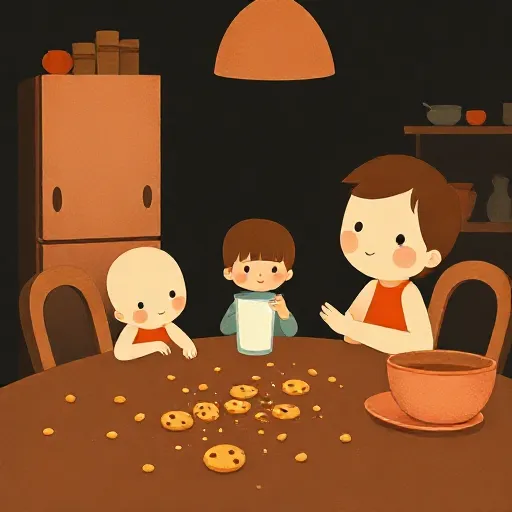
You shuffle into the kitchen early one morning, still half-asleep. On the table sits a plate with crumbs, a pat of butter, a jar of jam, an empty milk carton, and a used spoon. Nobody else is around. Without thinking much, you conclude: one of your housemates got up to make a midnight snack and was too tired to clean up.
You didn’t see it happen. You didn’t conduct a survey of nighttime snacking habits. Yet the conclusion feels almost automatic. How did you arrive at it? You looked at the clues and thought, “A sneaky snack is the best explanation for this mess.” That’s the kind of reasoning philosophers call abduction, or inference to the best explanation. It’s not a logical proof, and it’s not a statistical calculation. It’s more like detective work — and you do it all the time.
Three Ways Your Mind Jumps to a Conclusion
Philosophers usually sort inferences into three big types: deduction, induction, and abduction. Understanding the first two helps you see what makes abduction special.
Deduction is the only type where the conclusion must be true if the premises are true. For example: “All cats are mammals. Luna is a cat. So, Luna is a mammal.” The truth of those first two statements guarantees the third. The reasoning is airtight.
Induction relies on statistics or observed patterns. If you know that 96 percent of Flemish college students speak both Dutch and French, and Louise is a Flemish college student, you might conclude she probably also speaks both. But it’s not guaranteed — she could be in the tiny minority that doesn’t. Induction makes conclusions likely, not certain.
Abduction is different from both. It does not guarantee the conclusion, and it doesn’t rely on statistical data in any direct way. Instead, it appeals to explanatory power: a hypothesis is accepted because it would, if true, best explain the evidence. That’s exactly what you did with the kitchen mess. You didn’t know the odds of a midnight snack versus a burglar having a bite; you just judged that your housemate’s craving was by far the simplest and most reasonable story.
The philosopher Charles Sanders Peirce (1839–1914) first called this type of reasoning “abduction.” Later, Gilbert Harman (1938–2021) gave it the name many now use: inference to the best explanation. Peter Lipton (1954–2007) wrote a whole book exploring how it works.
Neptune, Electrons, and the Power of a Good Guess
Abduction isn’t just for figuring out kitchen mysteries. It has led to some of science’s most stunning discoveries.
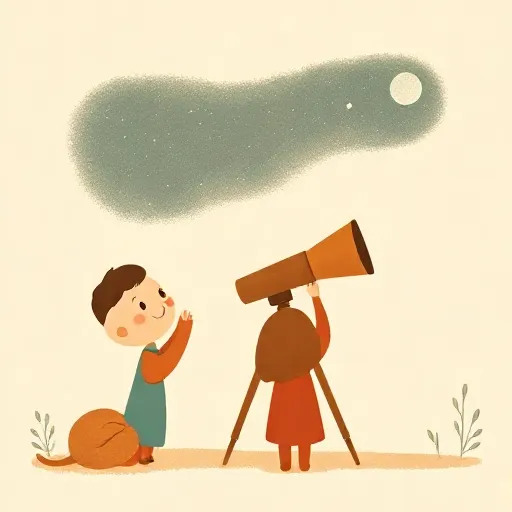
In the early 1800s, astronomers noticed that the planet Uranus was not following the orbit predicted by Isaac Newton’s theory of gravity. One possible explanation: Newton’s theory was wrong. But that theory had worked beautifully for two centuries. Instead, two astronomers, John Couch Adams and Urbain Le Verrier, independently suggested a better explanation — there must be an eighth, unseen planet tugging on Uranus. That hypothesis best explained the orbital oddity, and not long after, telescopes found Neptune right where the calculations said it should be.
A similar story played out in physics. The English scientist Joseph John Thomson studied cathode rays and found they carried negative charge, bent in electric and magnetic fields, and behaved exactly as if they were streams of tiny charged particles. No statistical survey could have told him that; the conclusion simply offered the best, perhaps the only plausible, explanation of his results. He had discovered the electron.
Philosophers point out that we also rely on abduction in everyday trust. When a friend tells you something, you don’t run a probability calculation — you accept the testimony because the best explanation for why she said it is that she believes it and wants you to know. Even understanding what someone means by a slightly odd sentence often involves a split-second abduction about what would make sense in context. Most of this happens so fast you never notice it.
The Trouble with “Best” Explanations

So abduction seems powerful. But is it truly a safe way to form beliefs? One of the biggest challenges is called the argument of the bad lot, introduced by Bas van Fraassen (born 1941).
A simple version of the abductive rule might say: “Given the evidence, look at the explanations you have, pick the one that explains it best, and conclude that explanation is true.” But imagine a detective with only three suspects. She may correctly judge that suspect number two is the most likely of the three. However, if the real culprit is someone she never even considered — someone not in her lineup — then her best explanation is still wrong. She has chosen the best of a bad lot.
The same worry applies to any abductive leap. We can only pick from the explanations we’ve managed to think up. There is no guarantee that the true explanation is on our mental list at all. Critics say this makes the rule unreliable unless we add extra restrictions, such as requiring the explanation to be “good enough” or only allowing a comparative conclusion (“this hypothesis is closer to the truth than the others”). Without those, abduction could easily lead us to confidently believe a false story.
Some reply that we can always add a catch-all hypothesis like “something else entirely,” but that is rarely informative or testable. The problem remains: abduction seems to assume we are lucky enough to have thought of the right answer, and that’s a big assumption.
Can We Defend Abduction?
Given the bad lot problem and other criticisms, philosophers have tried to show that abduction is still reasonable.
Bas van Fraassen raised a further worry: if one theory is more explanatory than another, it is often more detailed — and a more detailed theory has more ways to be false. How then can explanatory goodness point toward truth? And in the case of probabilistic versions of abduction, he argued they can lead to betting incoherence, which seems irrational.
Defenders have offered several replies. One famous argument comes from Richard Boyd (1942–2021). He noted that scientific methods work spectacularly well — they produce accurate predictions, technology, and ever-improving theories. Those methods rely heavily on background theories that were themselves accepted partly through abduction. The best explanation for the success of science, Boyd argued, is that those background theories are at least approximately true. Since abduction got us there, abduction must be reliable.
Critics object that Boyd’s argument itself uses abduction to defend abduction — that’s circular. Stathis Psillos (born 1965) responded that not all circularities are vicious. Boyd’s argument does not assume abduction is reliable from the start; it reaches that conclusion by a step that would have gone differently if abduction were unreliable. Others avoid circularity altogether by pointing to the track record of abductive inferences: we have many cases, like the discovery of Neptune, where an abductive guess was later confirmed. Through ordinary induction — not abduction — we can gather evidence that abduction tends to work.
The debate is alive. Some even suggest that abduction and probability theory (Bayesianism) might work together: explanatory reasoning could help us assign initial probabilities, and then standard rules take over. But critics push back, saying probability already works fine without adding explanation. No consensus has emerged.
Why We Can’t Stop Guessing the Best Story
Every time you figure out why a friend is quiet, why your phone won’t turn on, or who’s at the door from the sound of the knock, you’re doing abduction. It’s how you make sense of an often-messy world without waiting for a full scientific study. Doctors use it to diagnose illnesses. Juries use it to weigh evidence. Scientists use it to dream up new theories.
But the question of whether abduction is genuinely rational matters. If the bad lot problem is serious, then we should sometimes be far less confident in our best explanations than we naturally feel. On the other hand, if abduction has a good overall track record, perhaps it’s a tool we’re right to trust, even if it’s not perfect.
Philosophers haven’t settled this, and that makes your own everyday leaps a bit more interesting. The next time you look at a mess of crumbs, or hear a strange noise in the night, you’ll be using a reasoning style that sits at the heart of a centuries-old debate. And whether you know it or not, you’re taking a side.
Think about it
- If you have a really good explanation for something, but later find a clue that doesn’t fit, should you keep believing your explanation? Why or why not?
- Could a detective be justified in accusing someone if she knows there might be a better suspect she hasn’t thought of?
- Think of a time you figured something out by abduction. Could there have been another explanation you originally missed? How would you test it?